How to Grade Handwritten Exams Faster (AI Benchmark)
Grading handwritten exams takes weeks. Answer Sheet Evaluation by BigChalkBox processes a 500-student batch in under 15 minutes while faculty retain full approval control.
Impression-based grading causes subjective bias. Learn how Answer Sheet Evaluation applies exact criterion rubrics consistently across every paper.
A strong evaluation process removes the guesswork from grading. By breaking down answers into markable components, universities can guarantee consistency across massive cohorts.
| Component | Why it matters | Example |
|---|---|---|
| Criteria Definition | Aligns all evaluators on what constitutes a correct answer | Identifying key terms vs. full sentences |
| Weight Allocation | Prevents disproportionate penalty for minor errors | 2 marks for formula, 3 for calculation |
| Standardized Application | Ensures paper #500 is graded identically to paper #1 | Automated scoring engines applying the rubric without fatigue |
| Exception Handling | Captures novel but correct student interpretations | Faculty overrides for creative approaches |
The core philosophy of rubric-based grading is that no score should depend on the mood of the evaluator.
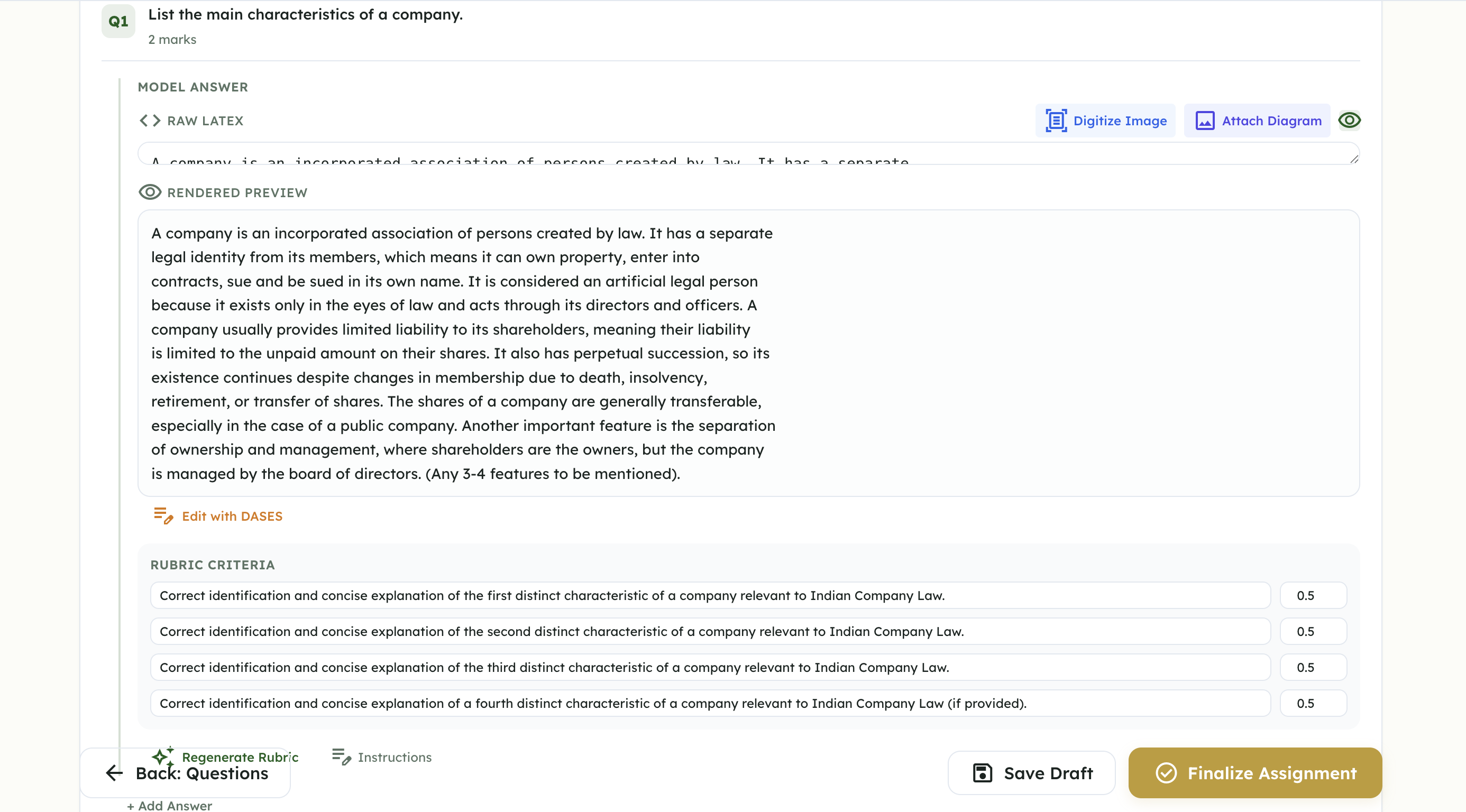
Faculty upload a model answer. Answer Sheet Evaluation generates the evaluation rubric for faculty review and adjustment.
Before any grading begins, the course coordinator must deconstruct the model answer into specific, observable elements. This is the foundation of rubric-based evaluation.
Instead of a generic instruction like "award 10 marks for a good essay," the rubric must specify exact criteria. For example, in an engineering exam, the rubric might allocate 3 marks for the correct diagram, 4 marks for the mathematical derivation, and 3 marks for the final calculated result.
This granular approach ensures that even if two different faculty members evaluate the same paper, they are looking for the exact same components.
A theoretical rubric often fails when exposed to real student answers. Therefore, calibration is a necessary step before scaling the evaluation process.
Faculty should select a random sample of 20-30 papers from different affiliated colleges and grade them using the drafted rubric. This exercise reveals ambiguous criteria or common student interpretations that the original rubric missed.
Once calibrated, the rubric is locked in, preventing the "shifting goalposts" problem that plagues manual grading.
Applying a detailed rubric manually to thousands of papers is exhausting, which is why institutions are moving toward automated scoring systems.
Once the rubric is defined, an AI engine can scan the digitized handwritten answers, locate the specific criteria (like the diagram or the derivation), and propose a score for each component independently. This ensures that the speed of grading handwritten exams is drastically increased without compromising the integrity of the rubric.
Automated scoring guarantees that the exact same standard is applied consistently across the entire batch.
One of the most contentious aspects of evaluation is awarding partial credit. A well-designed rubric handles this automatically.
If a student applies the correct formula but makes a calculation error in the final step, a holistic grader might arbitrarily deduct 5 marks. In a rubric-based system, the AI recognizes the correct formula and awards the 3 allocated marks, only deducting the 2 marks assigned for the final calculation.
This objective handling of partial credit drastically reduces student grievances and re-evaluation requests.
While AI can perfectly apply a defined rubric to thousands of papers, it cannot replace the academic judgment of a subject matter expert. Human oversight is mandatory, especially for highly creative or unconventional answers.
The Answer Sheet Evaluation module by BigChalkBox uses AI to map student handwriting against the faculty's rubric, proposing scores for each criterion. However, institutions maintain strict quality control because faculty members must review every single AI-proposed score and can override it with one click before results are published.
AI should be used to enforce the rubric consistently, but faculty must always make the final academic decision.
Poorly designed rubrics can cause more problems than they solve. Avoid these common pitfalls when transitioning to criterion-based grading.
Addressing these issues early ensures a smoother, more defensible evaluation cycle.
Before launching a large-scale evaluation using a new rubric, verify that these foundational elements are in place.
| Checkpoint | Yes or no |
|---|---|
| Criteria are observable and specific (not subjective) | |
| Partial credit weights are explicitly defined | |
| The rubric has been calibrated against sample papers | |
| All evaluators are trained on the rubric application | |
| The AI engine is configured to map to these specific criteria |
Checking these boxes guarantees that your evaluation process will be fair, consistent, and scalable.
Transitioning to rubric-based grading is the most effective way for universities to eliminate subjective bias, reduce re-evaluation requests, and ensure fairness across large student populations. When paired with automated scoring, it also becomes the fastest way to grade.
To see how your institution can digitize this entire workflow, learn more about managing answer sheet evaluation or book a free demo to experience BigChalkBox's rubric-based AI grading in action.