How to Grade Handwritten Exams Faster (AI Benchmark)
Grading handwritten exams takes weeks. Answer Sheet Evaluation by BigChalkBox processes a 500-student batch in under 15 minutes while faculty retain full approval control.
Managing thousands of scripts is an administrative nightmare. See how BigChalkBox digitizes and secures the entire evaluation workflow.
Physical evaluation centers are costly logistical nightmares prone to script loss. To manage answer sheet evaluation at scale, modern institutions use Answer Sheet Evaluation by BigChalkBox, a comprehensive university assessment platform. By digitizing scanned sheets, the AI handles the repetitive reading while human faculty handle the academic judgment securely from any location.
In the Indian higher education system, a single end-semester cycle can generate over 100,000 handwritten answer scripts. Managing this physical inventory requires renting massive halls, hiring security guards, and coordinating travel for hundreds of external evaluators.
During transport and handling, physical booklets are frequently damaged or entirely lost, triggering severe administrative crises. Furthermore, forcing faculty to travel to central evaluation centers disrupts their teaching schedules and leads to severe evaluator fatigue.
To scale operations safely, the evaluation process must be decoupled from the physical booklet. Digitization is the only viable path to managing massive exam volumes without compromising security or faculty well-being.
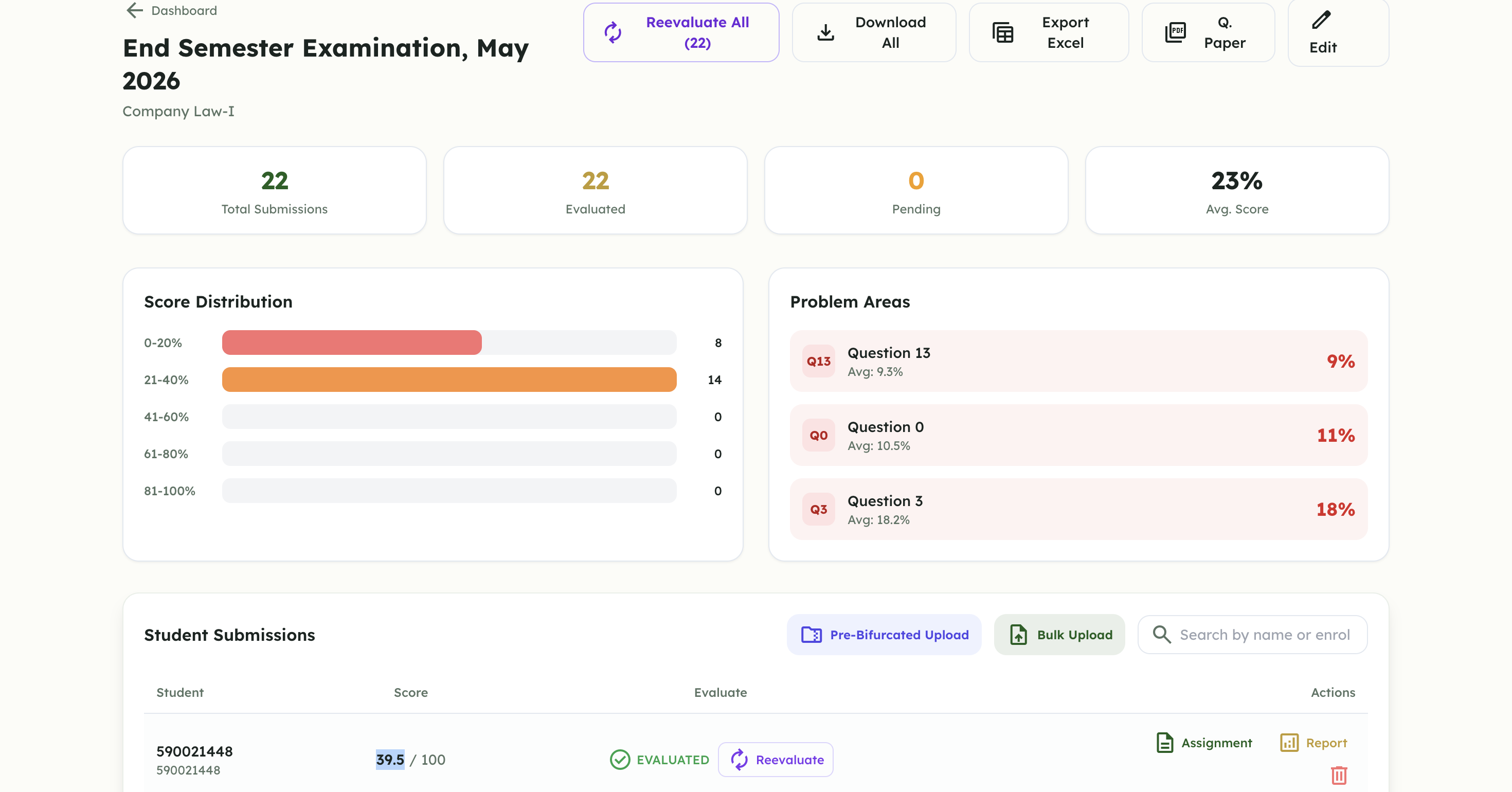
The batch-level results dashboard. The Controller of Exams can see full class performance and tracking metrics at a glance before publishing.
Transitioning to an education assessment software entirely eliminates the physical handling of papers after the initial scanning phase.
| Workflow Stage | Physical Evaluation Method | BigChalkBox Digital Method |
|---|---|---|
| Transport | Trucks move boxes to a central hall under guard. | Booklets are scanned locally; PDFs are securely uploaded. |
| Evaluator Access | Faculty travel to a central hall for 8-hour shifts. | Faculty log into a secure web portal from anywhere. |
| Calculation | Clerks manually tally marks on the front page. | System calculates partial scores and totals automatically. |
| Auditability | Impossible to track who evaluated which page. | Every click, override, and approval is digitally timestamped. |
This digital transformation reduces the evaluation lifecycle from weeks of grueling logistics to days of streamlined, secure online review.
Consider a state technological university trying to evaluate 50,000 engineering scripts across 20 affiliated colleges. Here is how a centralized digital platform manages the scale.
| Process Phase | System Action | Administrative Visibility |
|---|---|---|
| 1. Distributed Scanning | Colleges scan scripts locally and upload them to the central server. | Controller of Exams (COE) dashboard shows upload progress per college. |
| 2. AI Pre-processing | System parses handwriting, maps to rubrics, and generates proposed scores. | N/A (Background process handling thousands of pages per hour). |
| 3. Distributed Review | System securely routes specific scripts to designated faculty portals. | COE tracks exactly which faculty member is reviewing which batch. |
| 4. Human Approval | Faculty review AI scores, override where necessary, and click approve. | Dashboard updates in real-time as batches are finalized. |
| 5. Results Compilation | System aggregates all approved scores into the final university ledger. | COE exports the final verified results for publication. |
By centralizing the data but decentralizing the review process, the university eliminates transportation risks while drastically accelerating result declaration.
When scaling evaluation processes, administrators are often tempted to fully automate grading to save money. However, fully autonomous AI cannot grasp the nuanced pedagogical goals of specific university courses, leading to statistically dangerous grading anomalies.
BigChalkBox prevents this by mandating a "Human-in-the-loop" architecture. The system handles the heavy lifting: reading the handwriting, applying the rubric, calculating partial credits, and organizing the dashboard.
However, the AI's output is treated solely as a recommendation. A human faculty member must log in, review the AI's proposed score alongside the scanned script, and explicitly approve or override it. The platform manages the scale, but the human always manages the academic standard.
When universities attempt to modernize their evaluation workflows, they frequently make procurement errors. Avoid these common mistakes:
A true enterprise-scale platform must be secure, transparent, and built explicitly to assist the faculty, not replace them.
Before a university commits to digitizing a massive evaluation cycle, they should verify their infrastructure against this checklist:
| Readiness Check | Yes or no |
|---|---|
| Affiliated colleges possess high-speed batch scanners for local digitization | |
| The software automatically masks student identifying information on the scans | |
| The platform provides a centralized tracking dashboard for the Controller of Exams | |
| Faculty are trained on the "Human-in-the-loop" review and override process |
Confirming these prerequisites ensures that the university can securely manage a high-volume evaluation cycle from day one.
The days of renting massive halls and hiring security guards to protect thousands of paper booklets are over. By adopting a digital, AI-assisted platform, universities can decentralize their evaluation workforce while centralizing their security and oversight.
To see how a centralized dashboard manages a 50,000-script evaluation cycle in real-time, schedule a strategic consultation or explore the enterprise features of Answer Sheet Evaluation today.