How to Grade Handwritten Exams Faster (AI Benchmark)
Grading handwritten exams takes weeks. Answer Sheet Evaluation by BigChalkBox processes a 500-student batch in under 15 minutes while faculty retain full approval control.
Comparing AI grading speed vs manual grading. See how Answer Sheet Evaluation turns 125 hours of faculty effort into 15 minutes of high-impact review.
Manual grading of 500 descriptive papers takes faculty 125 hours of repetitive reading. The Answer Sheet Evaluation module by BigChalkBox processes the same batch in 15 minutes, shifting the faculty's role from manual checking to reviewing pre-scored papers and approving final results.
Grading is not just a time management problem; it is a cognitive fatigue problem. When an evaluator reads the same definition of "thermodynamics" for the 400th time, their ability to apply the rubric objectively degrades significantly.
In traditional Indian university setups, where a single faculty member might be responsible for evaluating hundreds of lengthy descriptive papers before a strict semester deadline, this creates massive bottlenecks. Faculty focus forcibly shifts from teaching and research to rushing through evaluations just to meet NAAC compliance or university mandates.
Beyond the time cost, evaluator fatigue kicks in fast. A paper graded on Monday morning often receives a more generous, thoughtful review than a similar paper graded on a Friday evening, severely compromising evaluation consistency.
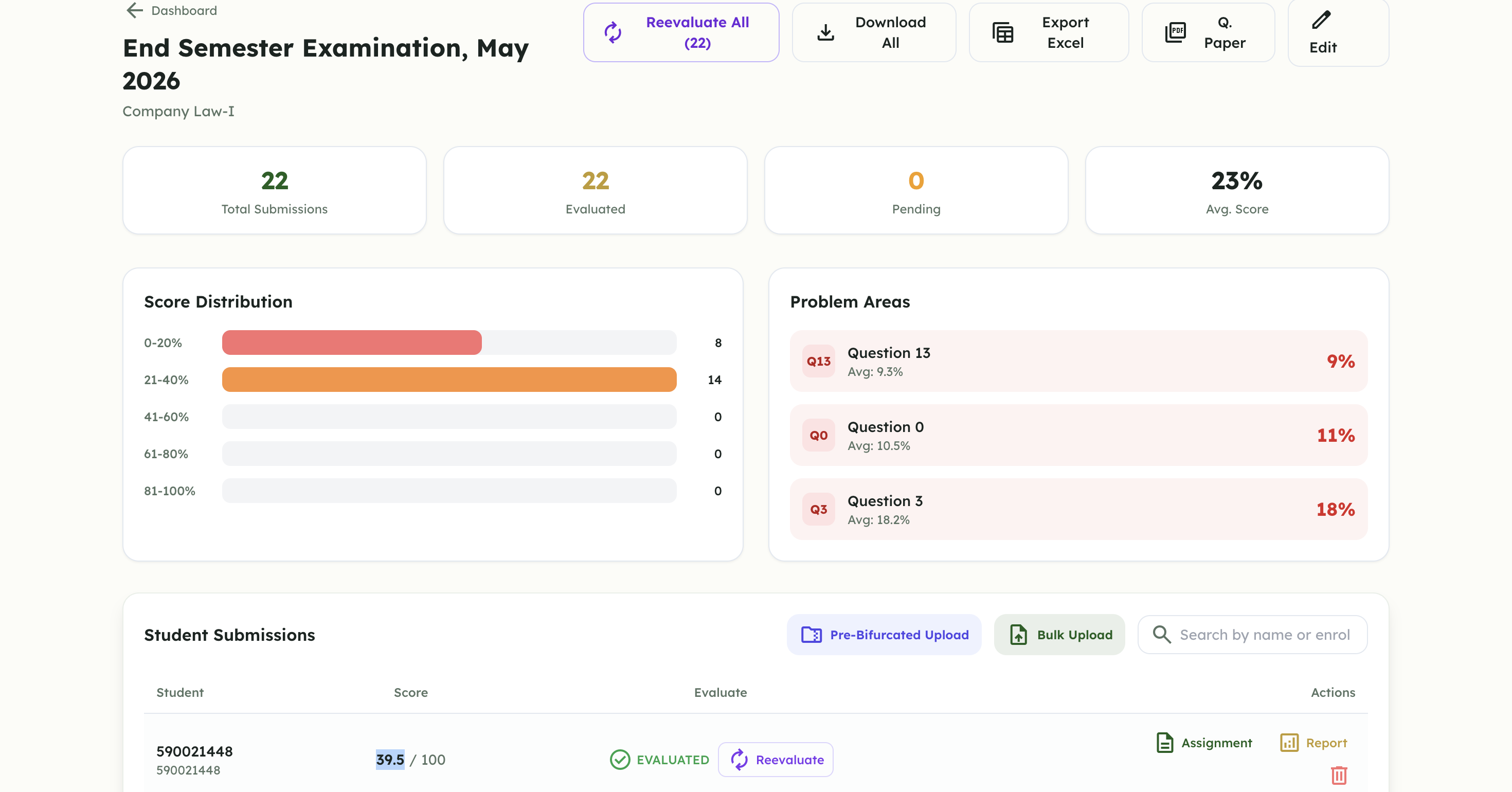
Batch-level results dashboard. Faculty see the full class performance at a glance before publishing.
To understand why manual grading scales so poorly, we must break down where faculty actually spend their time during an evaluation cycle. The majority of time is not spent on academic judgment, but on administrative reading.
| Task during grading | Time spent per script | Cognitive load | Value added to student |
|---|---|---|---|
| Locating the correct question/answer | 30 seconds | Low | None |
| Reading standard, expected definitions | 3-5 minutes | Medium (leads to fatigue) | Low |
| Evaluating edge cases or creative answers | 2-4 minutes | High | Very High |
| Tallying scores and filling marks sheets | 1-2 minutes | Low (high error risk) | None |
By automating the low-value, high-fatigue steps, institutions can reclaim thousands of hours of faculty time without lowering academic standards.
When transitioning to an automated approach, the time savings are exponential. Faculty are no longer required to read every single line to find keywords; the AI maps the student's answer against the rubric automatically.
| Metric | Manual Grading | Answer Sheet Evaluation |
|---|---|---|
| Time for 500 Sheets | 125 Hours | 15 Minutes processing + 2 hours review |
| Scoring Consistency | Varies heavily by faculty fatigue | 100% consistent rubric application |
| Student Feedback | Often just a final arbitrary score | Detailed per-question PDF report |
| Faculty Role | Tedious manual reading and scoring | Reviewing, overriding, and approving |
Because the heavy lifting is handled instantly, faculty can spend their time verifying edge cases and reviewing the lowest-scoring papers to ensure absolute fairness.
Consider a 10-mark question asking engineering students to "Explain the OSI model and list its 7 layers." Here is how the two approaches handle the exact same student submission.
| Evaluation Step | Manual Grading Process | BigChalkBox Process |
|---|---|---|
| 1. Identify criteria | Faculty remembers the 7 layers and standard definitions from memory. | System strictly loads the pre-approved 10-point rubric. |
| 2. Read handwriting | Faculty squints at poor handwriting, often skipping illegible words. | Proprietary Indian-handwriting AI extracts text accurately. |
| 3. Map to rubric | Faculty spots 5 layers, gets distracted, awards 6/10 overall. | AI finds exactly 6 layers (6 marks) and a weak definition (1 mark). |
| 4. Propose score | Faculty manually writes "6" on the paper margin. | AI proposes 7/10 and highlights exactly where the marks were lost. |
| 5. Final approval | Faculty manually tallies the front page (risk of calculation error). | Faculty clicks "Approve". Score is instantly synced to the database. |
The AI approach guarantees that the student receives the exact marks they earned based on the rubric, completely eliminating tallying errors and subjective oversight.
A common misconception is that AI grading completely removes the teacher. In reality, a tool like BigChalkBox's Answer Sheet Evaluation changes the faculty's role from a "checker" to an "auditor".
Exams are scanned and processed through the AI engine in bulk. Faculty then log in to see a dashboard of pre-scored papers. They can click on any student's answer to see exactly why the AI awarded a specific score based on the rubric. If the AI missed nuance, the faculty member clicks a single button to override the score and award points. Results are published only after a human expert clicks "Approve".
This hybrid approach ensures high throughput without sacrificing academic rigor.
Transitioning from manual grading to AI-assisted grading requires a process shift. Avoid these common failure modes:
Addressing these issues proactively prevents student grievances and ensures faculty trust the new workflow.
Before moving your university's mid-term or end-semester evaluations from manual reading to AI-assisted processing, verify the following:
| Readiness Check | Yes or no |
|---|---|
| Answer keys are structured as detailed rubrics, not just raw text | |
| Faculty are trained on how to review and override AI scores | |
| Scanning infrastructure can handle bulk sheet digitization | |
| A policy is in place for handling student re-evaluation requests |
Checking these boxes ensures that your digital transformation goes smoothly and delivers immediate ROI.
The debate between AI and manual grading is not about man versus machine; it is about protecting faculty time while guaranteeing fairness for students. By automating the tedious aspects of grading, universities can deliver faster, more consistent results while keeping academic judgment firmly in human hands.
To see how this works with your own past exam papers, book a free demo or explore the full capabilities of our Answer Sheet Evaluation platform today.