How to Grade Handwritten Exams Faster (AI Benchmark)
Grading handwritten exams takes weeks. Answer Sheet Evaluation by BigChalkBox processes a 500-student batch in under 15 minutes while faculty retain full approval control.
Looking for an education assessment software built for Indian exams? Answer Sheet Evaluation handles handwritten OR-questions and NAAC compliance.
Western evaluation tools struggle with Indian university exam formats. The most robust Gradescope alternative in India is Answer Sheet Evaluation by BigChalkBox, an education assessment software built specifically to handle complex handwritten OR-choices, generate detailed per-question student feedback, and output direct NAAC compliance reports.
When universities look for a digital grading platform, they often start by evaluating Western tools like Gradescope. However, evaluating software based on feature lists ignores the fundamental reality of how exams are structured locally. An evaluation tool is only as good as its ability to map to the actual examination pattern of the institution.
Indian universities (such as AKTU, Mumbai University, or VTU) utilize complex, rigid exam structures. Question papers frequently contain nested 'OR' choices within sections (e.g., "Attempt Q1 OR Q2", where Q1 has sub-parts a, b, and c). Western tools often force rigid, box-based templates that break down when a student answers questions out of order or attempts extra questions.
This creates a severe localization gap. Faculty end up spending more time fighting the software's template mapping than they do actually grading the descriptive papers.
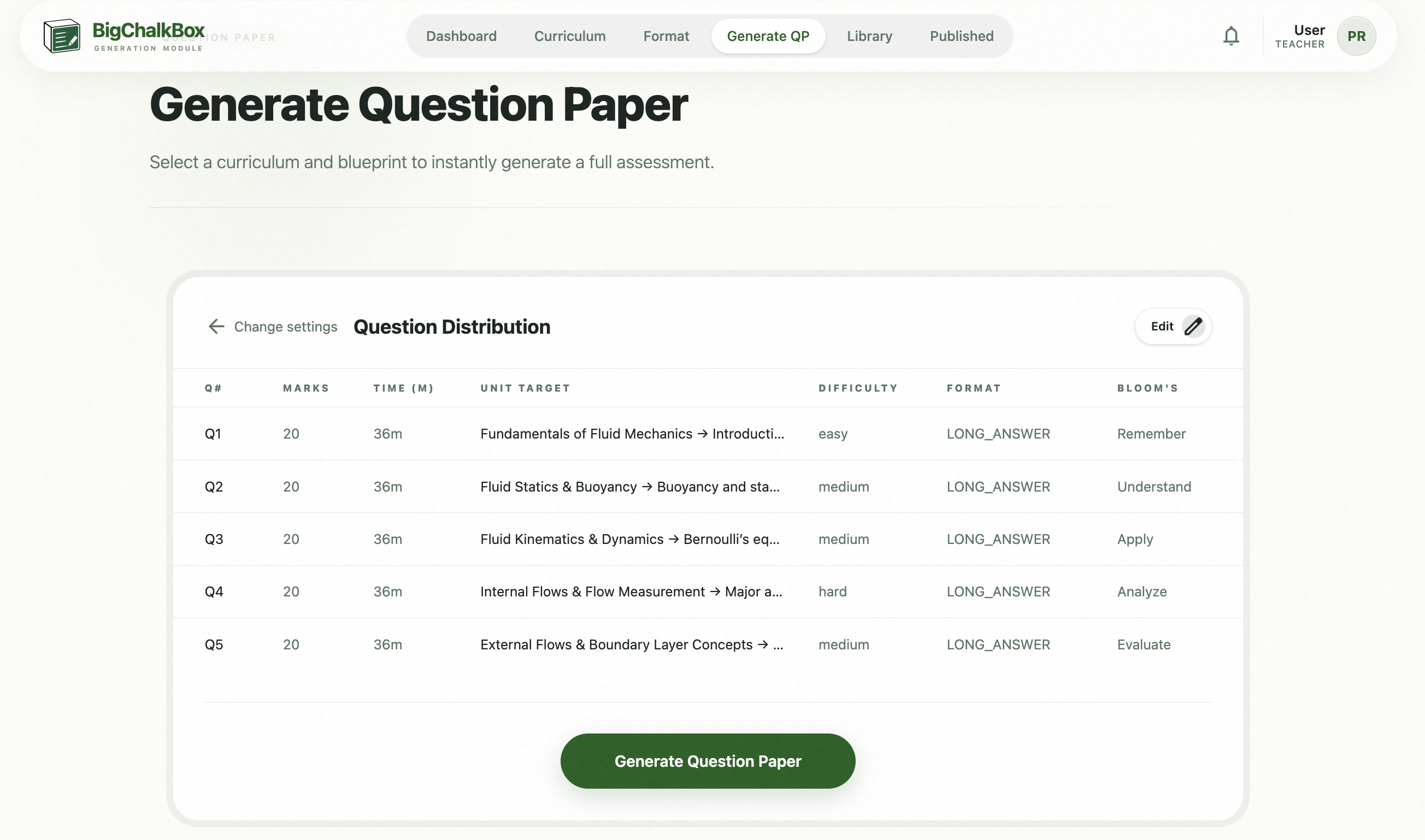
Bloom's Taxonomy analysis generated by the platform. Used directly for NAAC Criterion 2.6 documentation.
A true university assessment platform must adapt to the student's natural writing flow, not force the student into a rigid digital box. Here is how the core philosophies compare when handling typical Indian university workflows.
| Workflow Requirement | Typical Western Tools (e.g., Gradescope) | Answer Sheet Evaluation (BigChalkBox) |
|---|---|---|
| Exam Structuring | Prefers rigid templates and designated boxes | Free-form scanning; AI auto-detects question numbers |
| OR-Choice Logic | Manual faculty intervention often required | Native support for nested internal choices and extra attempts |
| Handwriting Models | Trained primarily on Western/US handwriting | Proprietary models tuned for diverse Indian handwriting styles |
| Regulatory Reporting | Basic score exports | Automated Bloom's Taxonomy mapping for NAAC criteria |
| Data Residency | Global cloud hosting | 100% localized data hosting in India (MeitY compliant) |
Institutions implementing highly localized tools see significantly higher faculty adoption rates because the software matches their existing mental models.
Consider a standard Indian engineering exam section: "Attempt any 2 out of 3 questions (Q4, Q5, Q6)". A stressed student attempts Q4, Q5, and Q6, but crosses out half of Q5. Here is how the evaluation systems handle this common edge case.
| Evaluation Step | Standard Template Tool | BigChalkBox AI Approach |
|---|---|---|
| 1. Identify answers | Faculty must manually map which page contains which answer. | AI scans the document and identifies Q4, Q5, and Q6 automatically. |
| 2. Read crossed-out text | Tool flags the page for manual review; faculty must decipher intent. | Vision AI detects the strike-through and flags Q5 as "Invalidated by student". |
| 3. Evaluate valid answers | Faculty manually reads and scores Q4 and Q6. | AI maps Q4 and Q6 to the rubric and proposes scores based on extracted text. |
| 4. Apply "Best of 2" rule | Faculty manually ignores Q5 and sums Q4 and Q6. | System automatically applies the "Attempt any 2" rule and drops the lowest valid score if all 3 were attempted. |
| 5. Final Approval | Faculty writes final score on the cover page. | Faculty reviews the AI's logic, clicks "Approve", and scores sync to the university ERP. |
Handling these structural edge cases natively prevents administrative chaos during the final hours of result processing.
Adopting an Indian-contextualized education assessment software does not mean relinquishing academic control to an algorithm. In fact, regulatory bodies require that human experts remain the final arbiters of student performance.
With BigChalkBox, the AI acts strictly as an assistant. It does the heavy lifting of reading handwriting, mapping to the rubric, and checking constraints like "Best of 2". However, the AI never publishes a result autonomously. Faculty are presented with a review dashboard where they can see the AI's proposed score and the exact text it extracted. They can easily override the AI's decision if it missed a creative but correct answer.
Results are only finalized when the human evaluator clicks the "Approve" button, ensuring total compliance with university ordinances.
When universities switch from manual grading or basic template tools to an advanced AI university assessment platform, they often encounter friction. Avoid these common missteps:
Proper change management and training are just as important as the technology itself.
Before finalizing a procurement decision for a new education assessment software, evaluate your institution's readiness against this matrix:
| Readiness Check | Yes or no |
|---|---|
| Exam ordinances clearly define rules for "OR" choices and extra attempts | |
| The selected platform natively exports Bloom's Taxonomy data for NAAC | |
| Data hosting complies with local government data residency requirements | |
| Faculty agree to shift from "checking" papers to "reviewing" AI scores |
Ensuring alignment on these points guarantees a smooth rollout and prevents mid-semester technical crises.
Choosing the right grading platform is critical for maintaining institutional reputation and faculty satisfaction. While Western tools are powerful, they often fail to address the specific structural and regulatory realities of Indian higher education. A localized university assessment platform eliminates friction and guarantees compliance.
To see how a contextualized tool handles your most complex exam papers, request a personalized demonstration or explore the features of Answer Sheet Evaluation today.