How to Grade Handwritten Exams Faster (AI Benchmark)
Grading handwritten exams takes weeks. Answer Sheet Evaluation by BigChalkBox processes a 500-student batch in under 15 minutes while faculty retain full approval control.
Struggling with Criterion 2.6? Learn how Question Paper Moderation automatically maps drafted exams to Bloom's Taxonomy for instant NAAC compliance.
Manually mapping exam questions to Bloom's Taxonomy is a subjective and time-consuming process. The fastest way to map exam questions is using an education assessment software like Question Paper Moderation by BigChalkBox. The AI analyzes the linguistic structure of drafted questions and automatically maps them to the correct cognitive level, generating verifiable documentation for NAAC Criterion 2.6, which faculty then review and finalize.
NAAC Criterion 2.6 requires Indian universities to prove they are evaluating higher-order thinking skills, not just rote memorization. Institutions must meticulously document the cognitive complexity of every question in their end-semester examinations.
Currently, faculty members manually tag their drafted questions against the six levels of Bloom's Taxonomy. Because verbs like "Describe" can imply mere recall in one context but deep understanding in another, this manual tagging is highly subjective. During a NAAC peer team visit, a poorly tagged question paper can easily result in lost accreditation points.
By leveraging a modern university assessment platform, institutions can standardize this mapping process using natural language processing, entirely removing human subjectivity from the compliance documentation.
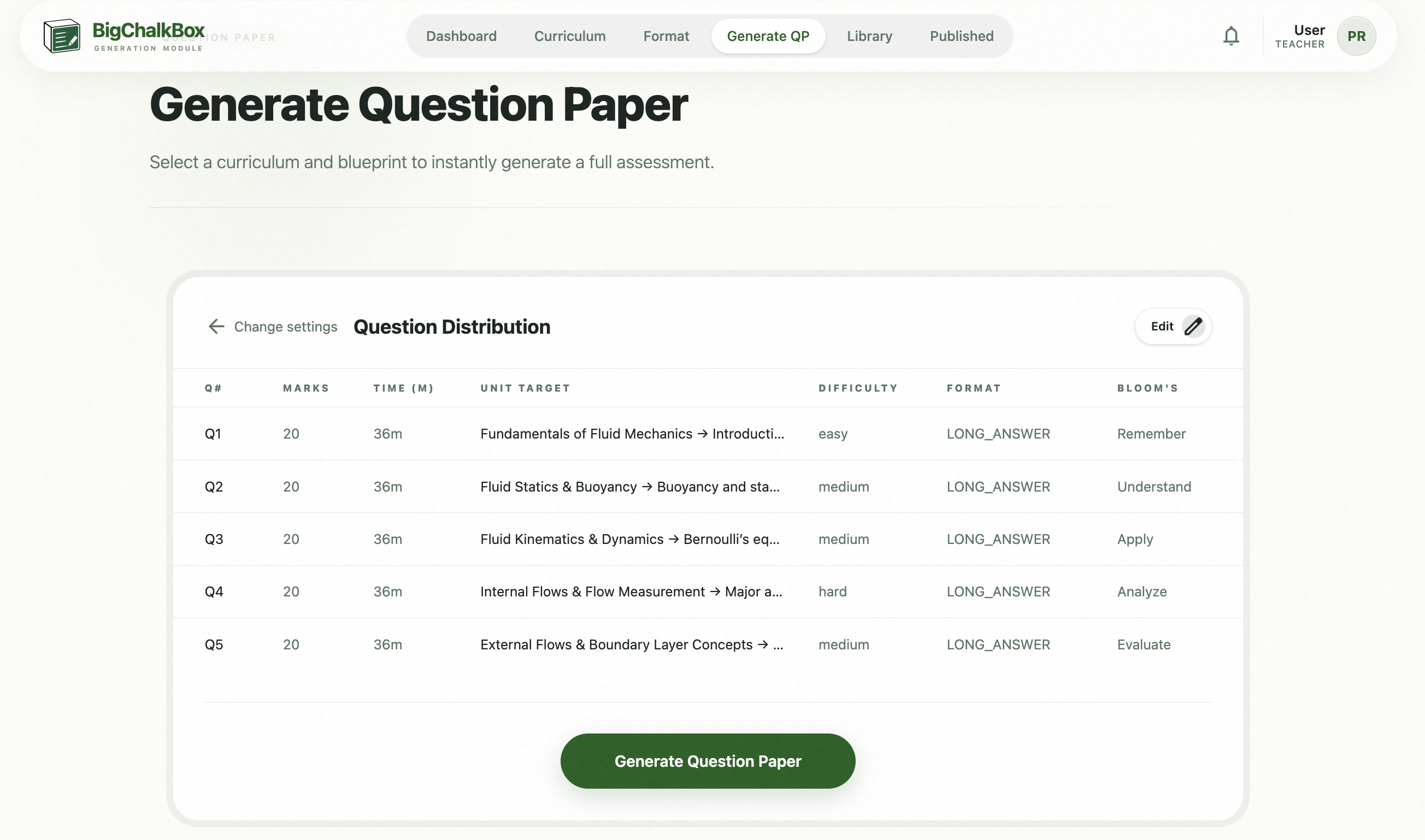
The Question Paper Moderation dashboard. The 10-point audit flags ambiguous questions and maps the entire paper to Bloom's Taxonomy automatically.
Automated moderation platforms analyze the semantic intent of the question, not just the starting verb.
| Mapping Criteria | Manual Faculty Estimation | BigChalkBox Automated Analysis |
|---|---|---|
| Verb Identification | Ctrl+F for keywords (e.g., "Analyze"). | Contextual NLP analysis of the entire sentence structure. |
| Level Assignment | Subjective "best guess". | Strict assignment to Remember, Understand, Apply, etc. |
| Report Generation | Manual data entry into Excel. | Instant export of NAAC-ready compliance PDFs. |
| Overall Balance | Eyeballed estimation of the paper. | Mathematical calculation of the exam's cognitive weightage. |
This automated rigor ensures that the university always has indisputable proof of their assessment quality.
Consider a moderation committee reviewing a drafted Physics question paper submitted by a junior faculty member.
| Audit Step | System Action | Committee Action |
|---|---|---|
| 1. Draft Upload | System reads the drafted Word document. | Committee uploads the junior faculty's draft. |
| 2. AI Analysis | AI maps the 20 questions in 3 seconds. | N/A (Background process). |
| 3. Discrepancy Alert | System flags Q4: Tagged "Evaluate" by faculty, but AI detects it is merely "Remember". | Committee reviews Q4 and agrees with the AI assessment. |
| 4. Paper Re-balancing | System shows the paper is 80% rote memorization. | Committee asks the AI to suggest higher-order alternatives for Section B. |
| 5. Final Export | System locks the revised paper and generates the NAAC report. | Committee approves the final, compliant examination paper. |
This transforms a contentious, hours-long moderation meeting into a swift, data-driven approval process.
While AI is excellent at linguistic analysis, it does not hold the academic mandate of the university. The AI might flag a question as being too simple, but the moderation committee might know that the specific cohort of students needs a gentle introduction to the topic.
BigChalkBox enforces a "Human-in-the-loop" moderation workflow. The AI acts as a tireless, objective auditor, flagging potential issues and suggesting taxonomy classifications across hundreds of papers simultaneously.
The human moderation committee retains absolute authority. They review the AI's audit report, and they can choose to ignore the warnings, override the taxonomy mappings, or manually rewrite the questions themselves. The AI advises, but the human committee decides.
When universities try to automate their NAAC compliance, they often rely on simplistic tools. Avoid these critical mistakes:
A reliable moderation platform must provide sophisticated semantic analysis while strictly preserving the human approval chain.
Before a moderation committee adopts automated Bloom's mapping, they should verify their infrastructure against this checklist:
| Readiness Check | Yes or no |
|---|---|
| The university has a standardized format for drafted question papers | |
| Faculty submit their drafts digitally rather than handwritten | |
| The moderation committee is trained on the NAAC 2.6 requirements | |
| The platform allows committee members to override AI tags |
Confirming these prerequisites ensures that the AI can seamlessly integrate into the university's existing quality assurance processes.
The era of subjective arguments over Bloom's Taxonomy in moderation meetings is over. By adopting an AI-powered moderation tool, universities can guarantee the cognitive rigor of their exams and generate flawless compliance reports instantly.
To see how a drafted exam is audited and mapped in under 5 seconds, schedule a strategic consultation or explore the features of Question Paper Moderation today.