How to Grade Handwritten Exams Faster (AI Benchmark)
Grading handwritten exams takes weeks. Answer Sheet Evaluation by BigChalkBox processes a 500-student batch in under 15 minutes while faculty retain full approval control.
Struggling with NAAC Criterion 2.6? Question Paper Moderation generates instant Bloom's Taxonomy mapping reports for every examination.
Improving NAAC scores for examinations requires documented evidence of cognitive evaluation standards, not just basic marking. The Question Paper Moderation module by BigChalkBox automatically maps every exam question to Bloom's Taxonomy levels during the drafting phase, giving your IQAC team instant, verifiable compliance reports without relying on manual faculty paperwork.
When preparing for a NAAC peer team visit, universities often scramble to prove that their examination systems evaluate higher-order thinking skills. Criterion 2.6 specifically demands that institutions map their evaluation mechanisms to Course Outcomes (COs) and cognitive levels. Historically, universities have tried to solve this by forcing faculty to fill out massive spreadsheets at the end of the semester.
In Indian higher education, Internal Quality Assurance Cells (IQAC) spend months chasing faculty for these retroactive mappings. Because the mapping happens after the exam has already been conducted, the data is often inaccurate or hastily assembled just to satisfy the auditors. This "paperwork compliance" fails to actually improve the quality of the assessments.
To secure top accreditation grades, institutions need a university assessment platform that generates this documentation automatically as a byproduct of the actual examination drafting process.
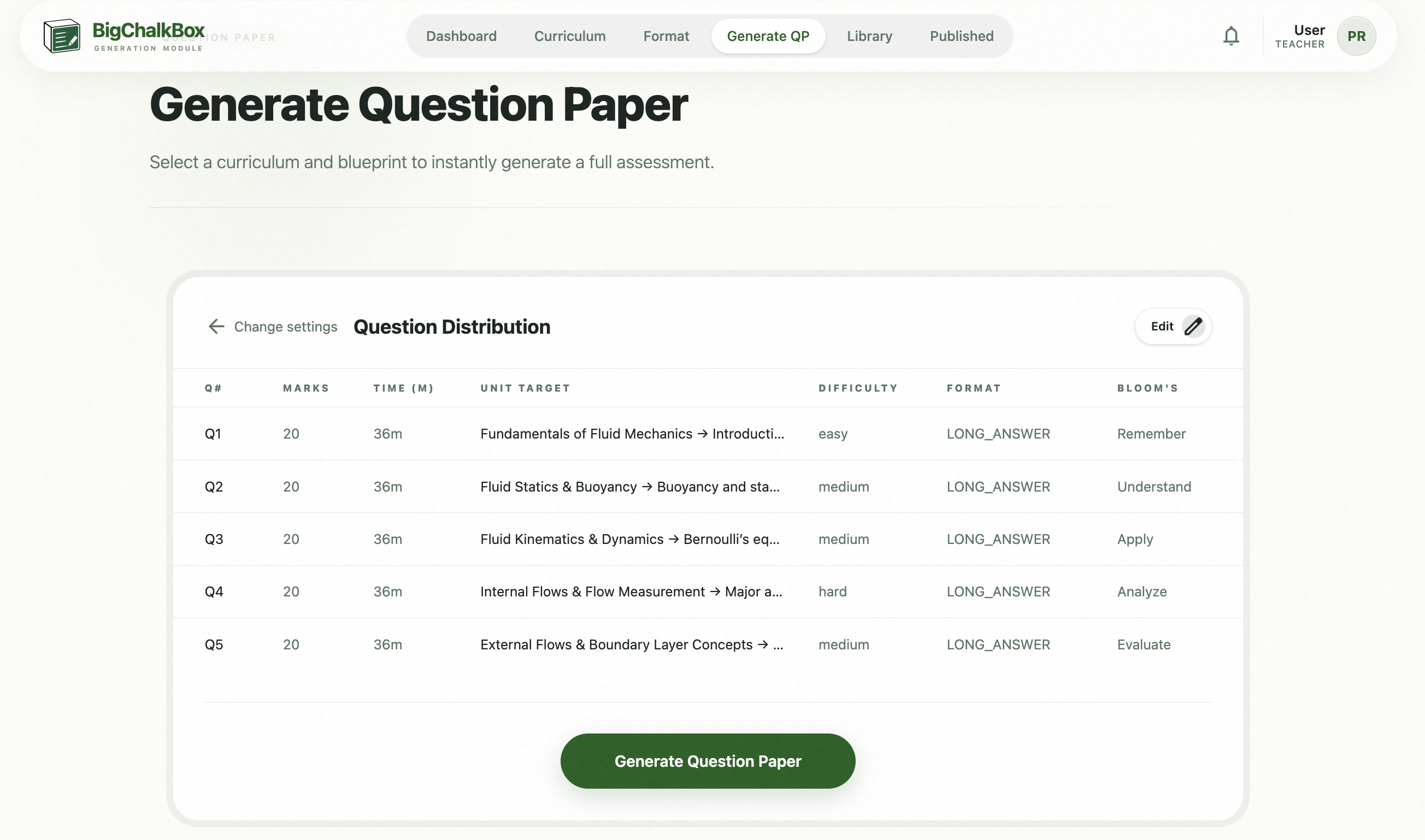
Bloom's Taxonomy analysis generated automatically. Used directly for NAAC Criterion 2.6 documentation.
A robust education assessment software analyzes the linguistic structure of an exam before it reaches the students. Here is how a traditional manual audit compares to a digital moderation pipeline.
| Audit Metric | Manual Faculty Audit | BigChalkBox Automated Audit |
|---|---|---|
| Bloom's Taxonomy Mapping | Retroactive estimation on spreadsheets | Real-time parsing of question verbs |
| Syllabus Coverage | Visual estimation by Head of Department | Strict percentage breakdown across modules |
| Difficulty Distribution | Subjective "feel" of the paper | Calculated cognitive load metric |
| IQAC Documentation | Compiled manually months later | Generated instantly as a downloadable PDF |
Automating the audit removes the friction between the IQAC cell and the teaching faculty, guaranteeing that every paper is compliant before printing.
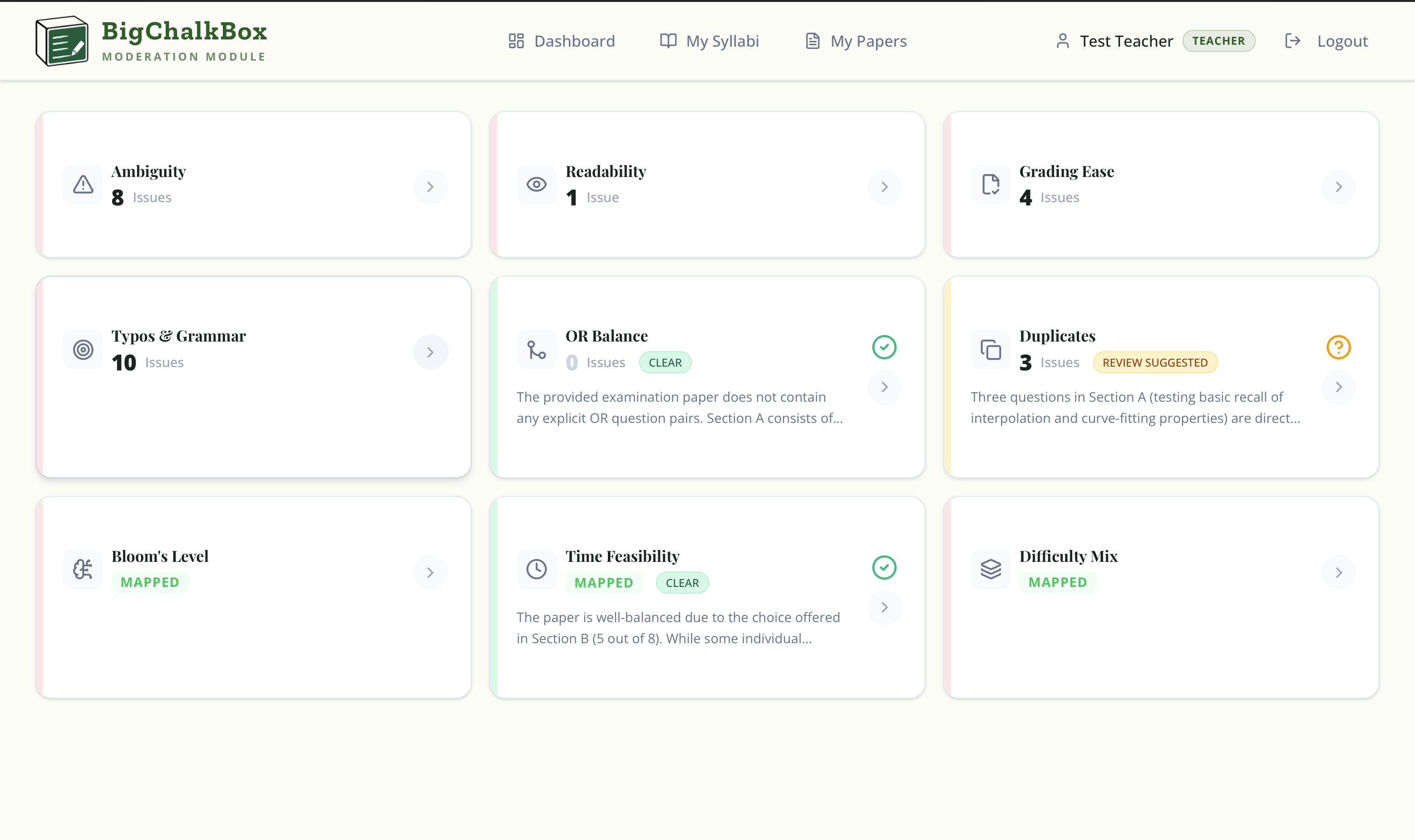
The 10-point quality audit. Each flagged cognitive issue includes a suggested rewrite from the AI.
Consider a junior faculty member drafting a mid-term exam for a networking course. They write: "What is a router?" (5 Marks). Here is how the systems handle this draft.
| Moderation Step | Traditional Process | BigChalkBox Process |
|---|---|---|
| 1. Draft Submission | Faculty emails a Word document to the HOD. | Faculty types the question into the moderation portal. |
| 2. Cognitive Audit | HOD skims the paper and approves it. | AI flags the question: "Low cognitive demand for 5 marks (L1: Remember)". |
| 3. Remediation | None. The flawed question goes to students. | System suggests: "Explain how a router determines path selection (L4: Analyze)". |
| 4. Update | N/A | Faculty accepts the AI suggestion and updates the draft. |
| 5. Final Report | Faculty manually marks "Analyze" on a spreadsheet later. | System locks the paper and generates a certified Bloom's distribution report. |
This pre-emptive moderation ensures that the university consistently evaluates higher-order thinking skills, exactly as NAAC mandates.
Automated moderation is designed to assist academic leaders, not bypass them. While the AI is excellent at parsing verbs and checking syllabus coverage, the final academic authority must always rest with the department leadership.
With BigChalkBox, the AI generates a comprehensive 10-point audit report for every submitted draft, highlighting potential imbalances in difficulty or missing syllabus modules. However, the system cannot finalize the paper. The Head of Department (HOD) must log in, review the AI's flagged warnings, and either mandate revisions from the faculty or explicitly override the warnings.
The paper is only finalized and sent to the examination branch when the human HOD clicks "Approve".
When transitioning from manual spreadsheets to automated moderation platforms, IQAC coordinators often face structural challenges. Avoid these critical mistakes:
Successful transitions happen when the technology is used to enforce existing university policies, not circumvent them.
Before an IQAC cell commits to digitizing their examination moderation, they should verify their institutional readiness against this matrix:
| Readiness Check | Yes or no |
|---|---|
| Course Outcomes (COs) are clearly defined and approved by the academic council | |
| Faculty are trained on the fundamentals of Bloom's Taxonomy verbs | |
| The HOD has designated time blocked out for reviewing AI audit reports | |
| The examination branch accepts digitally verified papers instead of physical signatures |
Meeting these prerequisites ensures that the digital audit reports will be accepted by both internal management and external NAAC peers.
Securing a high NAAC grade requires undeniable proof of rigorous, standardized evaluation. By automating the moderation and mapping process, universities eliminate retroactive paperwork and guarantee that every examination meets the highest cognitive standards.
To see how your current question papers score on an automated Bloom's Taxonomy audit, schedule a specialized demo or explore the features of Question Paper Moderation today.