How to Grade Handwritten Exams Faster (AI Benchmark)
Grading handwritten exams takes weeks. Answer Sheet Evaluation by BigChalkBox processes a 500-student batch in under 15 minutes while faculty retain full approval control.
Grading STEM papers requires complex extraction. See how Answer Sheet Evaluation parses equations, diagrams, and multi-step derivations.
STEM exams are notoriously difficult to automate because they rely on non-linear logic, symbols, and visual representations. To grade math exams with diagrams using AI, Answer Sheet Evaluation by BigChalkBox isolates visual elements from text, parsing multi-step derivations and drawn diagrams, and scoring them against the faculty's step-by-step rubric. Human educators then review every proposed score before finalization.
Standard grading automation typically relies on identifying keywords in a paragraph of text. However, in Science, Technology, Engineering, and Mathematics (STEM) subjects, this linear approach fails entirely. An engineering exam answer is rarely just text; it is a hybrid of descriptive theory, mathematical derivations, and hand-drawn schematics.
In Indian higher education, where engineering colleges process hundreds of thousands of complex answer scripts per semester, the inability to automate STEM grading creates a massive bottleneck. Evaluators must spend hours manually tracing a student's logic through dense calculations.
Modern university assessment platforms solve this by using specialized computer vision models that treat mathematical symbols and drawn diagrams as structural data rather than standard prose.
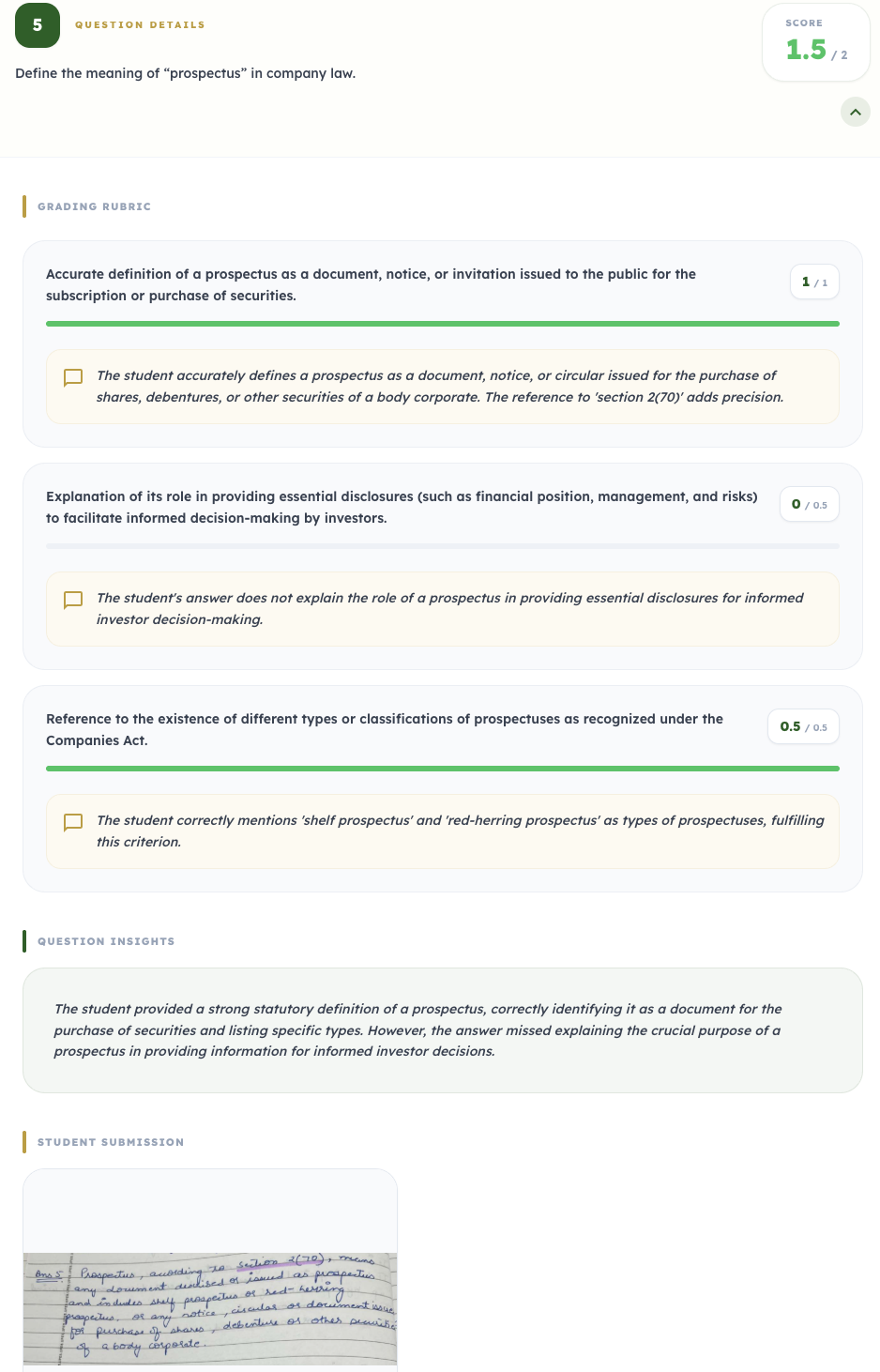
The review dashboard handling a multi-step STEM question. Faculty retain full override capabilities.
A robust education assessment software must apply different logic engines depending on the type of content it encounters on the page.
| Content Type | AI Parsing Method | Evaluation Outcome |
|---|---|---|
| Mathematical Derivation | Symbolic logic mapping | Awards partial credit for correct intermediate steps |
| Engineering Diagram | Structural computer vision | Checks for correct node connections and labels |
| Chemical Equation | Contextual syntax analysis | Verifies compound balancing and valency |
| Graph Plot | Coordinate extraction | Validates axis labeling and curve trajectory |
By splitting the page into these sub-components, the AI can evaluate highly complex answers using the exact same logic an engineering professor would apply.
Consider a 5-mark electronics question: "Draw a full-wave bridge rectifier circuit and explain its operation." The rubric assigns 3 marks to the diagram and 2 marks to the theory. Here is how the system handles the hybrid answer.
| Evaluation Phase | System Action | Score Proposed |
|---|---|---|
| 1. Segmentation | System separates the drawn circuit from the written paragraph below it. | N/A |
| 2. Diagram Analysis | Vision model checks for 4 diodes in a bridge configuration, AC input, and DC load. | 2/3 (Student forgot to label the load resistor). |
| 3. Theory Analysis | NLP engine maps the paragraph text for concepts of "alternating cycles" and "forward bias". | 2/2 (Explanation is conceptually sound). |
| 4. Compilation | Logic engine sums the sub-scores. | Total proposed: 4/5. |
| 5. Faculty Review | Faculty sees the extracted diagram and the specific missing label highlighted. | Faculty clicks "Approve". |
This granular approach ensures that students are rewarded for exactly what they know, rather than being penalized with a blunt "0" for a minor drawing error.
While AI is highly adept at parsing standard diagrams and equations, student creativity in STEM subjects is boundless. A student might invent a completely novel, yet mathematically valid, way to solve a calculus problem that does not match the faculty's standard model answer.
Because of this, BigChalkBox mandates a "Human-in-the-loop" architecture. The AI acts as a high-speed assistant, calculating partial credits and highlighting errors. However, the system cannot finalize the score. The result is quarantined in a dedicated review dashboard.
The faculty member must review the student's handwritten logic against the AI's proposed score. If the student used a valid alternative method, the faculty simply overrides the AI's score with a single click. The human always retains ultimate academic authority.
When university IT departments attempt to automate engineering and math exams, they often fail to account for the nuances of STEM evaluation. Avoid these critical mistakes:
A successful deployment requires software specifically engineered for the structural complexity of scientific examinations.
Before an engineering or science faculty commits to an automated grading platform, they should verify their readiness against this matrix:
| Readiness Check | Yes or no |
|---|---|
| The software can distinguish between drawn diagrams and written text on the same page | |
| The rubric engine allows assigning distinct weights to specific derivation steps | |
| Faculty are trained to define clear, step-by-step marking schemes for the AI | |
| The review dashboard allows instant overrides for alternative solving methods |
Confirming these capabilities ensures that the platform will actually reduce the faculty's grading workload rather than complicate it.
Evaluating mathematical derivations and engineering diagrams no longer requires hours of manual scrutiny. By deploying an AI engine capable of structural and symbolic parsing, universities can accelerate their STEM evaluations while maintaining absolute accuracy.
To see the extraction models parse a complex engineering drawing in real-time, schedule a specialized technical demo or explore the features of Answer Sheet Evaluation today.