How to Grade Handwritten Exams Faster (AI Benchmark)
Grading handwritten exams takes weeks. Answer Sheet Evaluation by BigChalkBox processes a 500-student batch in under 15 minutes while faculty retain full approval control.
Indian exams use complex OR-choices. Answer Sheet Evaluation automatically detects which question the student attempted and applies the correct rubric.
Indian exam formats frequently feature complex 'attempt Q1 OR Q2' structures that break generic text parsers. An advanced university assessment platform like Answer Sheet Evaluation by BigChalkBox automatically detects which option the student answered based on semantic context, applies the corresponding faculty-defined rubric, and routes the calculated score to the human faculty review panel.
When western developers build education assessment software, they assume a linear, predictable test structure. Student writes Answer 1 below Question 1, Answer 2 below Question 2, and so on. In Indian higher education, this assumption is completely false.
Indian university examinations are built around choice. A standard engineering paper might require students to "Attempt any 5 out of 8 questions in Part A" and "Answer Q9(a) OR Q9(b) in Part B." Students write these answers in a blank 30-page booklet, in whatever order they please, often forgetting to write the question number.
Manual evaluators spend a significant portion of their time simply hunting through booklets to figure out which question the student actually attempted before they can even begin grading. An automated solution must perform this mapping intelligently.
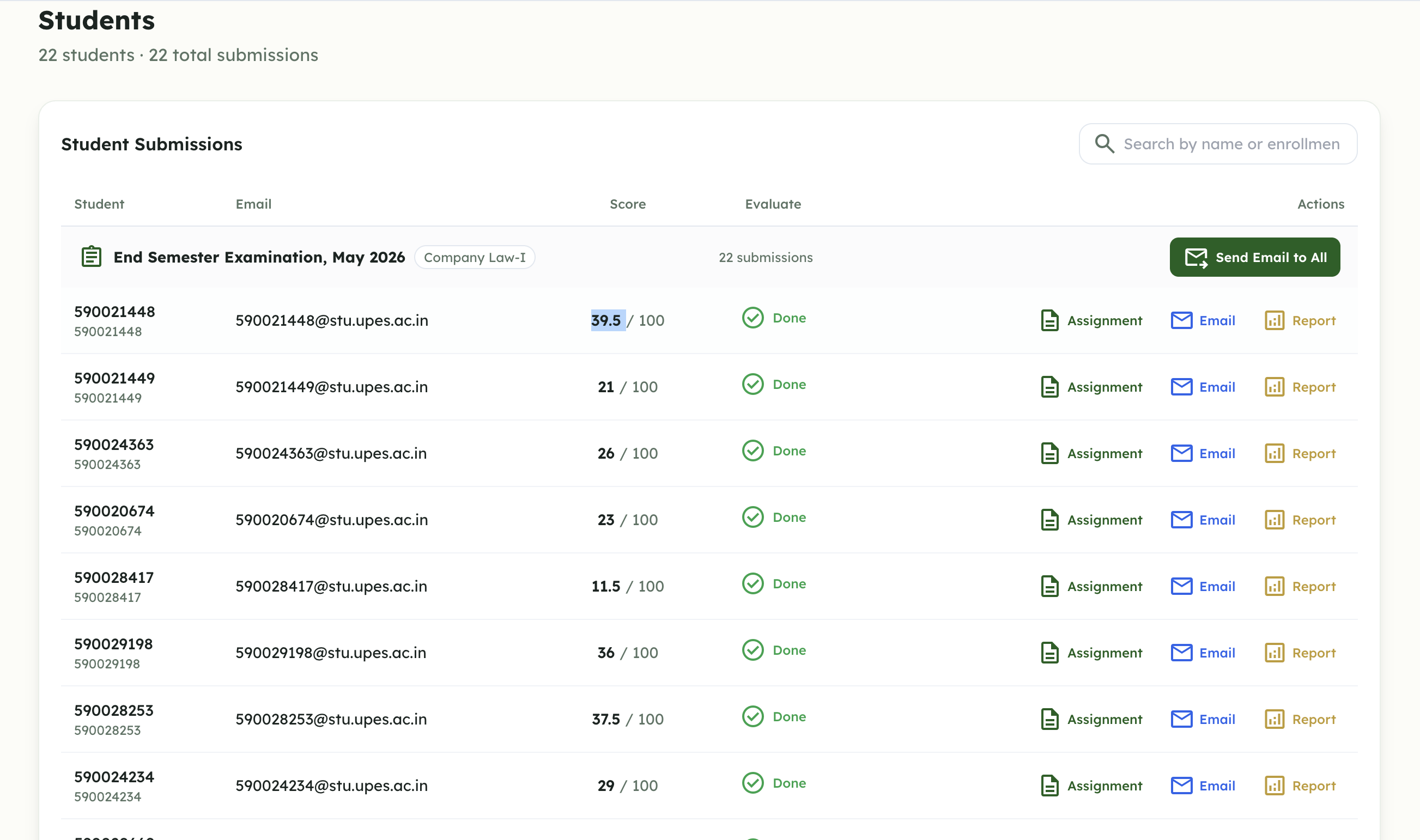
The review panel explicitly flags 'OR' conflicts. Faculty review the AI-generated scores and resolve the conflict with one click before results are published.
To solve the "OR" choice problem, a grading platform must abandon rigid zone-based scanning and instead use semantic intent mapping.
| Choice Structure | Traditional Scanning Approach | BigChalkBox Semantic Approach |
|---|---|---|
| Direct OR (Q1a vs Q1b) | Fails if student writes in the wrong physical box on the page. | Reads the text and maps it to the closest matching rubric. |
| "Best of" (Any 5 of 8) | Cannot tally subsets. | Evaluates all attempted answers, automatically applies top 5 to total. |
| Missing Question Numbers | Assigns a "0" for the unmapped zone. | Deduces the intended question based on the student's written concepts. |
| Attempting Both Choices | System crashes or adds both scores illegally. | Scores both, flags the policy conflict for the human evaluator to resolve. |
By mapping answers based on what the student wrote rather than where they wrote it, the system accommodates the chaotic reality of handwritten examinations.
Consider a chaotic submission where a student is asked to "Attempt any 3 out of 5 short notes." The student actually writes 4 short notes, hoping the examiner will only count the highest scores.
| Mapping Phase | System Action | Faculty Visibility |
|---|---|---|
| 1. Ingestion | System identifies 4 distinct blocks of text on the page. | N/A (Background process). |
| 2. Semantic Matching | System maps Block 1 to Q2, Block 2 to Q3, Block 3 to Q4, and Block 4 to Q5. | N/A (Background process). |
| 3. Evaluation | Scores are calculated: Q2(2/5), Q3(4/5), Q4(3/5), Q5(5/5). | N/A (Background process). |
| 4. Logic Application | System drops Q2 (the lowest score) based on the "Best 3" rule. | Faculty sees Q3, Q4, Q5 highlighted as "Counted". Q2 is marked "Struck out". |
| 5. Final Review | System calculates total: 12/15. | Faculty reviews the logic, clicks "Approve", and finalizes the score. |
This automated logic application eliminates the manual arithmetic errors that trigger thousands of student re-evaluation requests every semester.
While the AI can mathematically calculate the "Best of" scores, different universities have different disciplinary policies regarding over-attempting questions. Some institutions penalize the student, while others generously award the highest marks.
BigChalkBox is designed to act as an enforcer of your specific institutional policy, not a replacement for it. If a student blatantly violates a structural rule (e.g., answering both Q1a AND Q1b when explicitly told to choose one), the AI evaluates both but quarantines the paper.
When the authorized faculty member logs into the review dashboard, the system displays a glaring "Policy Conflict" warning. The human evaluator then decides whether to strike out the second answer or apply a penalty, ensuring the AI never makes an unauthorized disciplinary decision.
When controllers of examinations attempt to digitize their workflows, they often purchase generic scanning tools that create more problems than they solve. Avoid these implementation errors:
A true education assessment software handles the structural mapping invisibly, presenting the faculty with a clean, organized review interface.
Before a university shifts its complex, choice-heavy exams to a digital platform, they should verify their setup against this checklist:
| Readiness Check | Yes or no |
|---|---|
| The software maps answers based on semantic content, not just page location | |
| The platform automatically applies "Best of" calculation logic to the final tally | |
| The system explicitly flags "over-attempted" policy violations for human review | |
| The university's specific marking rules have been pre-configured in the platform |
Confirming these structural capabilities ensures the platform can handle the reality of the university's examination formats without manual intervention.
Indian universities do not need to abandon their rigorous, choice-based examination formats just to achieve digital efficiency. By leveraging semantic mapping, institutions can automate the tedious arithmetic of "OR" choices and "Best of" rules while keeping human educators firmly in control of the final academic judgment.
To see how semantic mapping handles your most complex examination formats in real-time, schedule a strategic consultation or explore the structural logic capabilities of Answer Sheet Evaluation today.