How to Grade Handwritten Exams Faster (AI Benchmark)
Grading handwritten exams takes weeks. Answer Sheet Evaluation by BigChalkBox processes a 500-student batch in under 15 minutes while faculty retain full approval control.
Stop guessing on paper quality. Question Paper Moderation audits your exams for ambiguity, syllabus alignment, and cognitive depth.
Institutions struggle to objectively prove exam quality to accreditors. To ensure exam paper quality for NAAC compliance, universities use Question Paper Moderation by BigChalkBox, an advanced education assessment software. It runs a 10-point audit on drafted papers, flagging out-of-syllabus questions and ambiguous phrasing with AI-suggested rewrites, which human faculty then review and approve.
For Indian universities, the National Assessment and Accreditation Council (NAAC) grade dictates funding, reputation, and autonomy. NAAC places heavy emphasis on the quality of student assessment. However, proving that thousands of internal exam papers meet high cognitive standards is notoriously difficult.
Traditionally, exam moderation is a subjective, closed-door process. Senior faculty glance through papers drafted by juniors, often missing subtle ambiguities or failing to map questions to specific Course Outcomes (COs). This lack of documented, objective quality control results in poor NAAC scores.
By digitizing the moderation process with a university assessment platform, institutions generate an irrefutable, digital audit trail proving that every single question was rigorously evaluated before the exam was administered.
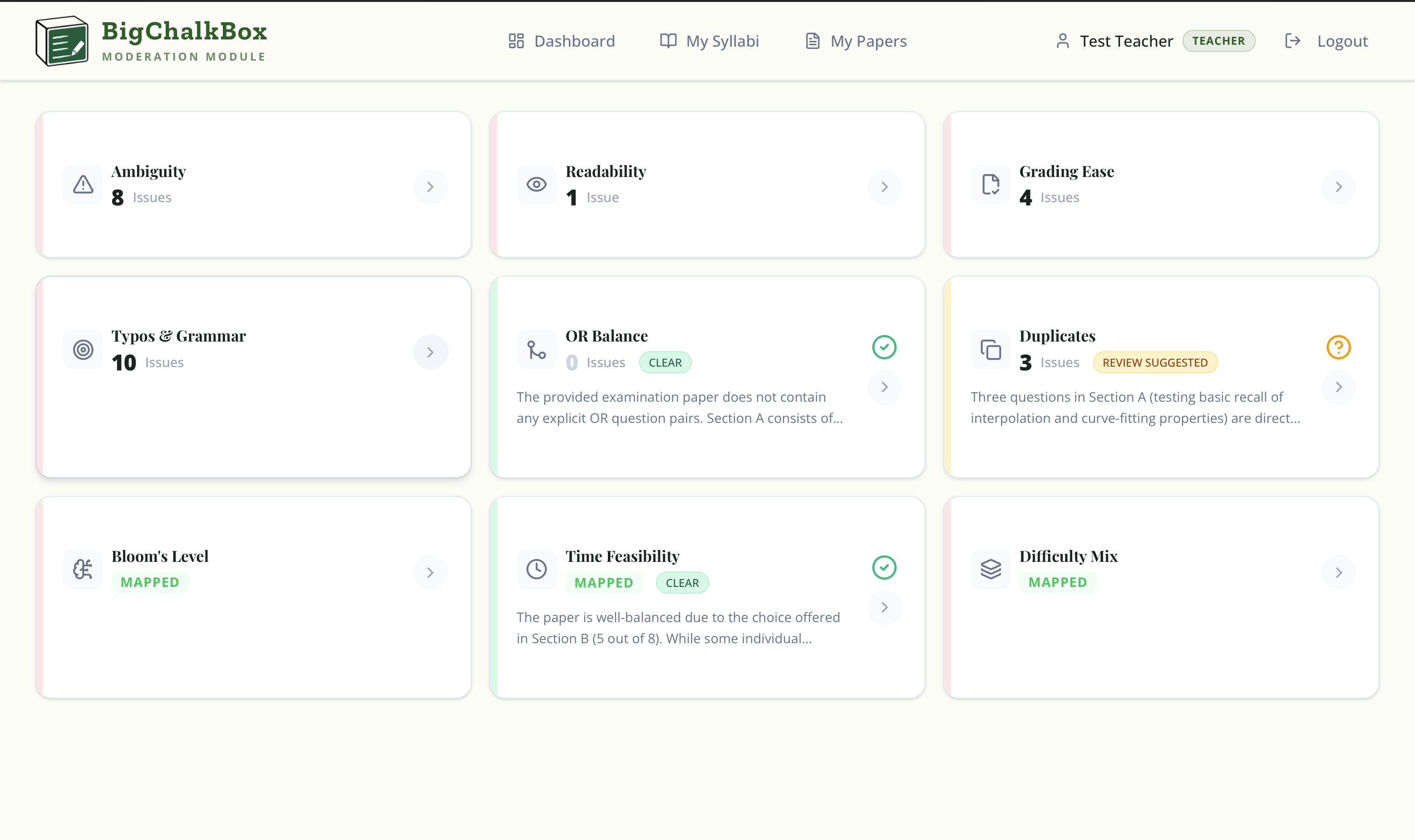
The digital review dashboard showing the 10-point quality audit. Each flagged issue includes a suggested rewrite for the human moderator to review.
An AI-assisted moderation tool removes subjectivity by evaluating every drafted question paper against a strict, multi-point rubric.
| Audit Parameter | Manual Moderation Limit | BigChalkBox AI Capability |
|---|---|---|
| Syllabus Alignment | Relies on the moderator's memory. | Cross-references every question against the exact uploaded syllabus document. |
| Bloom's Taxonomy | Often ignored or mapped incorrectly. | Analyzes verbs and phrasing to accurately classify cognitive depth. |
| Language Clarity | Subjective grammar checks. | Flags complex sentence structures that might confuse ESL students. |
| Difficulty Balance | Eyeballed estimation. | Mathematically analyzes historical data to project the paper's overall difficulty. |
By surfacing these objective metrics instantly, the AI allows human moderators to focus their expertise on high-level academic refinement rather than basic proofreading.
Consider a junior faculty member submitting a drafted question for a 3rd-year Economics paper: "Discuss inflation and how it affects things in India."
| Moderation Phase | System Action | Faculty Review |
|---|---|---|
| 1. Draft Submission | AI ingests the drafted question paper. | Moderator opens the digital review dashboard. |
| 2. Quality Audit | AI flags the question as "Ambiguous/Vague" and "Low Cognitive Depth". | Moderator views the specific flags triggered. |
| 3. Rewrite Suggestion | AI suggests: "Analyze the impact of rising inflation rates on the purchasing power of the Indian middle class." | Moderator evaluates the AI's suggestion. |
| 4. Human Decision | System waits for authorization. | Moderator clicks "Accept Suggestion" to update the draft. |
| 5. Audit Logging | System logs the original draft, the AI flag, and the moderator's final decision. | University now has proof of active quality assurance for NAAC. |
This collaborative workflow ensures that exams are consistently rigorous and clearly phrased, eliminating student confusion in the examination hall.
While AI is excellent at enforcing structural rules and flagging grammatical ambiguity, it lacks the contextual nuance of a tenured professor. The AI does not understand the specific pedagogical goals of a unique departmental course.
For this reason, BigChalkBox's architecture relies on the "Human-in-the-loop" principle. The AI performs the initial 10-point audit and generates suggestions, but it cannot alter the exam paper independently. The moderation report is purely advisory.
A designated faculty moderator must review the AI's flags. If the AI suggests a rewrite that alters the academic intent of the question, the faculty member simply rejects the suggestion. The human expert always retains the final say on what appears on the exam.
When universities attempt to standardize their exam moderation processes, they often fall into administrative traps. Avoid these critical mistakes:
Effective quality assurance requires digital tools that support, rather than bypass, human academic judgment.
Before a university attempts to digitize its moderation workflow for NAAC compliance, it should verify its readiness against this checklist:
| Readiness Check | Yes or no |
|---|---|
| Syllabus documents are digitized and ready to be fed into the mapping engine | |
| Course Outcomes (COs) are clearly defined for every subject | |
| The moderation platform generates downloadable audit logs for accreditation proof | |
| The system mandates human review before any drafted question is finalized |
Confirming these prerequisites ensures that the transition to digital moderation will directly yield the evidence required by accreditation bodies.
Securing a top NAAC grade requires more than just claiming high standards; it requires proving them through documented workflows. By deploying an AI-assisted moderation platform, universities can guarantee that every examination administered meets the highest cognitive and structural benchmarks.
To see the 10-point quality audit identify flaws in a drafted exam paper in real-time, schedule a specialized technical demo or explore the compliance features of Question Paper Moderation today.