How to Grade Handwritten Exams Faster (AI Benchmark)
Grading handwritten exams takes weeks. Answer Sheet Evaluation by BigChalkBox processes a 500-student batch in under 15 minutes while faculty retain full approval control.
Curious about the technology? See the 3-step pipeline: handwriting extraction, semantic mapping, and rubric-based scoring.
AI exam grading is not an opaque black box; it is a highly structured, three-step natural language processing pipeline. First, Answer Sheet Evaluation by BigChalkBox extracts handwriting from scanned PDFs. Second, it maps the extracted text to semantic meaning. Third, it scores that meaning against a faculty-defined rubric. Faculty then review every score on a dashboard before results are finalized.
When university administrators first encounter an education assessment software that claims to read descriptive answers, the immediate reaction is skepticism. How can a machine understand the nuance of a 5-page essay or a complex engineering derivation? The answer lies in breaking down the problem.
In Indian higher education, transparency is critical for both student trust and regulatory audits. An AI cannot simply output a final score of "8/10" without explaining its logic. If the system cannot demonstrate exactly which rubric criteria the student met, the platform is useless for academic applications.
Modern university assessment platforms solve this by separating the optical character recognition (OCR) phase from the semantic evaluation phase, creating a verifiable audit trail at every step.
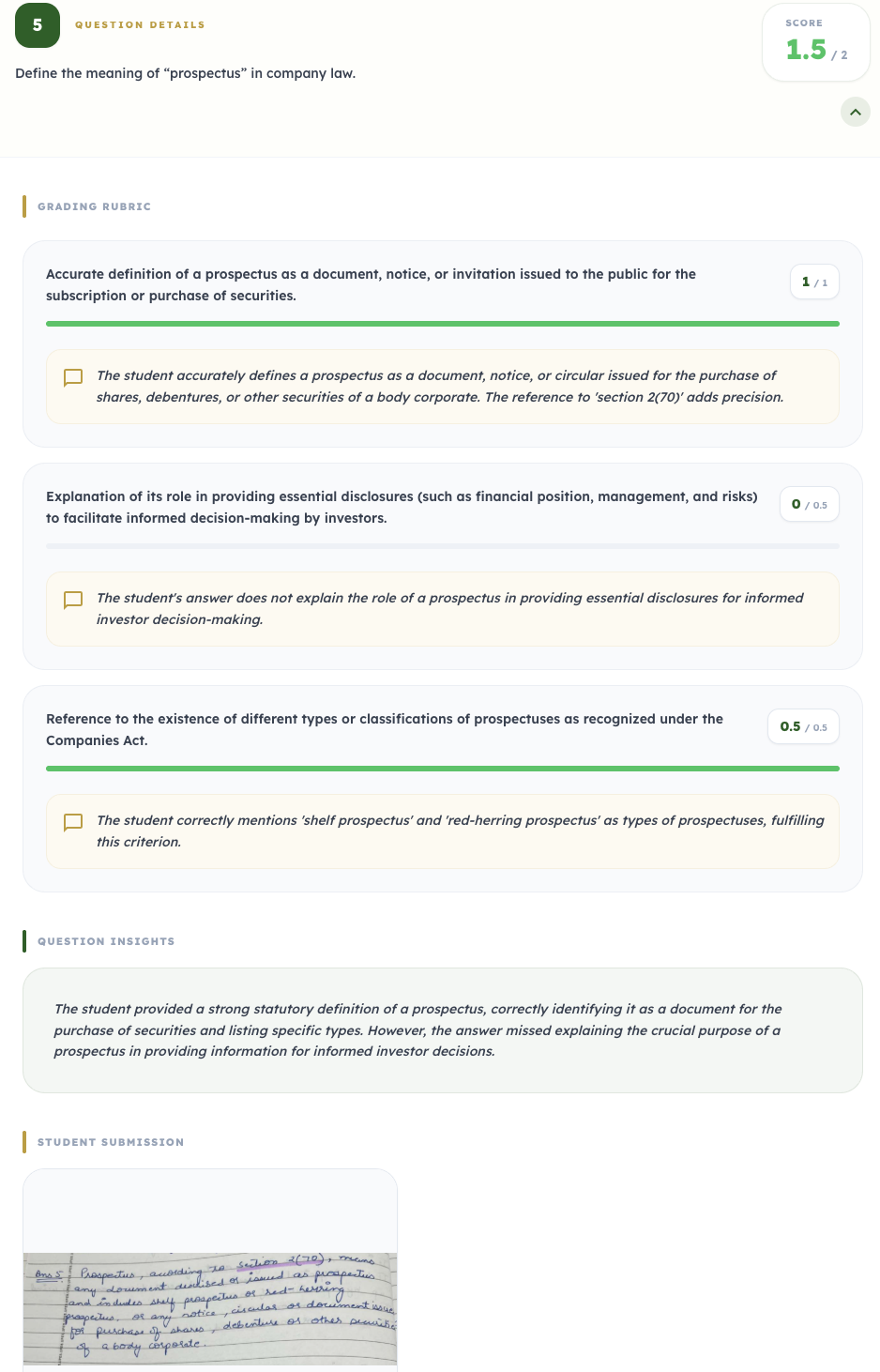
The review dashboard. Faculty can see the original scan, the extracted text, and the rubric logic side-by-side.
A robust grading engine processes a raw, scanned PDF through three distinct layers before proposing a score to the faculty member.
| Pipeline Stage | Technical Process | Output Provided to Faculty |
|---|---|---|
| 1. Extraction (Vision) | Proprietary OCR tuned for regional handwriting styles | A digital, searchable transcription of the student's text |
| 2. Comprehension (NLP) | Semantic parsing of arguments, ignoring grammatical errors | Identification of key concepts and logical flows |
| 3. Scoring (Logic) | Mapping comprehended text against the strict rubric | Proposed score breakdown with highlighted text evidence |
Because each step is distinct, faculty can easily identify if an error occurred due to messy handwriting (Step 1) or a poorly defined rubric (Step 3).
Consider a biology question worth 2 marks: "Define Photosynthesis." The rubric requires two concepts: "conversion of light to chemical energy" (1 mark) and "using chlorophyll" (1 mark). A student with poor handwriting scribbles: "plants use lite to make chem energy with clorofil."
| Pipeline Step | System Action | System Output |
|---|---|---|
| Raw Input | Scan is uploaded as a 200 DPI JPEG. | Image of handwritten scribble. |
| Extraction | Vision model corrects skew and identifies characters. | "plants use lite to make chem energy with clorofil." |
| Comprehension | NLP engine normalizes spelling and maps semantic intent. | Intent: Light energy -> Chemical energy. Catalyst: Chlorophyll. |
| Scoring | Logic engine compares intent against the 2-point rubric. | Award 1 mark for energy conversion. Award 1 mark for catalyst. |
| Final Proposal | System flags the response for faculty review. | Proposes 2/2 marks, linking the specific student words to the rubric. |
The NLP engine's ability to ignore spelling mistakes ("lite", "clorofil") and focus on semantic meaning is what separates modern AI from outdated keyword-matching tools.
Despite advances in natural language processing, AI is not flawless. Highly creative answers, illegible handwriting, or out-of-syllabus responses can confuse the models. This is why autonomous grading is strictly prohibited in serious academic deployments.
With BigChalkBox, the system is designed with a "Human-in-the-loop" (HITL) architecture. If the AI encounters handwriting it cannot parse with 95% confidence, it stops evaluating and flags the answer for manual review. Even when the AI successfully scores a paper, the result is quarantined in a dashboard.
Faculty must log in, review the AI's logic alongside the original scanned image, and click "Approve" or "Override". This ensures the technology assists the educator without overriding their authority.
When IT departments deploy a new education assessment software, they often overlook the practical realities of the faculty workflow. Avoid these technical pitfalls:
Addressing these technical requirements prior to deployment ensures the pipeline operates at maximum efficiency.
Before transitioning to an AI-driven evaluation pipeline, university IT administrators should verify their infrastructure against this checklist:
| Readiness Check | Yes or no |
|---|---|
| The platform utilizes NLP for semantic meaning, not just keyword matching | |
| The system provides a clear audit trail linking proposed scores to the rubric | |
| The UI allows faculty to view the original scan side-by-side with the score | |
| The platform vendor provides direct API endpoints for ERP integration |
Confirming these features ensures that the selected university assessment platform is technically sound and faculty-friendly.
Understanding the technical pipeline behind AI grading demystifies the process and builds trust among faculty. By separating extraction, comprehension, and scoring into distinct, verifiable steps, universities can achieve massive scale without sacrificing transparency.
To see this three-step NLP pipeline evaluate your own past exam papers in real-time, request a technical demonstration or explore the architecture of Answer Sheet Evaluation today.