How to Grade Handwritten Exams Faster (AI Benchmark)
Grading handwritten exams takes weeks. Answer Sheet Evaluation by BigChalkBox processes a 500-student batch in under 15 minutes while faculty retain full approval control.
Stop delaying results. Answer Sheet Evaluation by BigChalkBox processes thousands of scripts in hours, turning exam checking into a streamlined, faculty-approved digital process.
Manual grading causes weeks of result delays for large universities. The Answer Sheet Evaluation module by BigChalkBox eliminates this bottleneck by processing up to 5,000 sheets in a single afternoon. Faculty set the rubrics, the AI applies them consistently, and faculty approve the final results before publishing.
When university administrators discuss exam result delays, they often blame faculty for reading too slowly. In reality, the physical logistics of exam checking are far more debilitating than the reading itself. An education assessment software must solve the logistics problem before it can solve the grading problem.
Consider a standard Indian state university with 50 affiliated colleges. Moving 100,000 physical answer booklets from examination centers to central evaluation hubs requires armed transport, secure storage rooms, and armies of clerks just to bundle and unbundle papers. The physical movement alone adds weeks to the result declaration timeline.
Digital grading platforms bypass this entirely by capturing the data at the source, allowing faculty to evaluate from any secured terminal instantly.
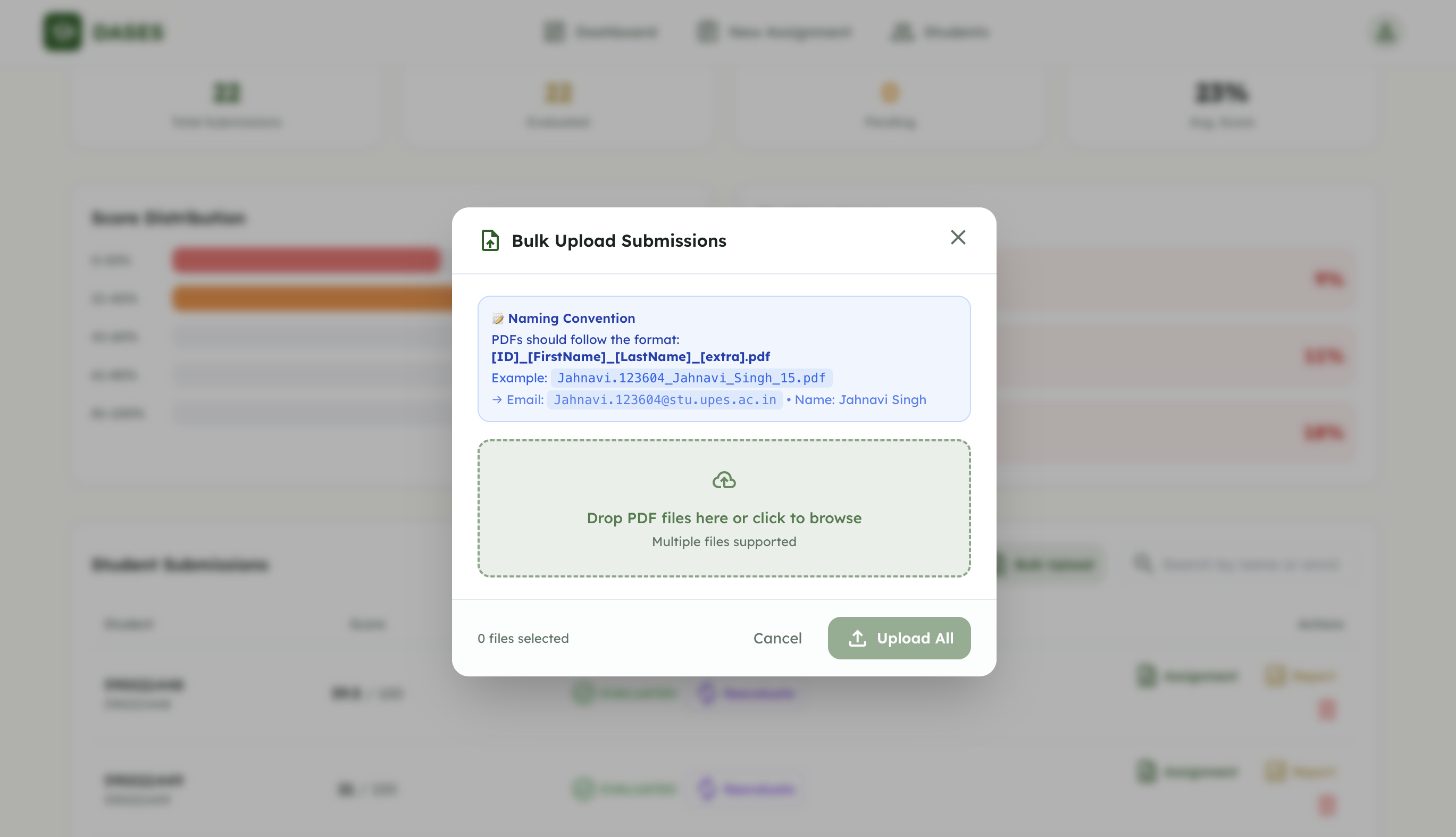
Faculty and admins can upload bulk batches of scanned answer sheets to begin an evaluation session.
Understanding the true cost of physical evaluations requires mapping out the administrative overhead. Here is how the manual process compares to a digital university assessment platform.
| Logistical Step | Manual Paper Process | BigChalkBox Digital Process |
|---|---|---|
| Transportation | Trucks move papers to central hubs (Days) | Scanned at college, uploaded instantly (Minutes) |
| Bundling/Anonymization | Clerks manually tape over roll numbers (Hours) | System automatically hides student identity (Instant) |
| Distribution | Faculty wait in lines for paper bundles (Hours) | Digital bundles assigned to dashboards (Instant) |
| Evaluation | Faculty manually read and score (Weeks) | AI pre-scores based on rubric; faculty reviews (Days) |
| Result Tallying | Clerks manually type scores into ERP (Days) | Scores sync automatically upon approval (Instant) |
Eliminating the physical movement of paper guarantees that results are declared on time, preventing student protests and maintaining academic schedules.
Imagine an End-Semester examination for a first-year "Engineering Physics" paper with 5,000 enrolled students across 10 colleges. The exam finishes at 1:00 PM.
| Timeline | Traditional Manual Workflow | Answer Sheet Evaluation Workflow |
|---|---|---|
| 1:00 PM - 3:00 PM | Papers are sealed in boxes at 10 colleges. | Papers are bulk-scanned and uploaded via secure portal. |
| Day 1 - Day 3 | Boxes travel to the central university hub. | AI engine maps all 5,000 scripts against the rubric. |
| Day 4 - Day 14 | Faculty physically travel to the hub to grade. | Faculty log in from home, review AI scores, and approve. |
| Day 15 - Day 18 | Clerks manually enter written marks into Excel. | (Task eliminated. Scores already synced). |
| Day 19 | Results are finally declared. | Results were declared on Day 5. |
By operating digitally, the university cut the evaluation timeline by 14 days, saving massive administrative costs and travel allowances.
Speed cannot come at the cost of academic integrity. When processing thousands of scripts, an AI-powered education assessment software must remain subordinate to human judgment. Autonomous grading without review violates fundamental academic principles.
With Answer Sheet Evaluation, the AI acts as a high-speed assistant. It handles the OCR, mapping, and preliminary scoring, but it stops there. The system routes the pre-scored digital bundles to the assigned faculty evaluators. Evaluators can click on any score to see the AI's exact justification. If the AI misunderstood a poorly drawn diagram, the evaluator clicks "Override" and updates the score.
No student result is finalized until a verified faculty member clicks the "Approve Bundle" button.
Universities rushing to modernize often choose software that looks good in a demo but fails in real-world scenarios. Avoid these severe operational mistakes:
A systematic rollout strategy is critical for avoiding faculty backlash during the first digital exam cycle.
Before a university Controller of Examinations signs off on a new grading platform, they should verify the following readiness criteria:
| Readiness Check | Yes or no |
|---|---|
| The platform supports free-form handwritten descriptive answers | |
| Affiliated colleges possess scanners capable of 40+ pages per minute | |
| The system provides a clear dashboard for faculty to review and override scores | |
| The platform vendor offers direct onboarding and training for evaluators |
Checking these boxes ensures that the investment actually resolves the evaluation bottleneck rather than creating new technical hurdles.
The era of manual, paper-based evaluations is rapidly closing. Universities that refuse to adopt a digital university assessment platform will continue to suffer from delayed academic calendars, frustrated students, and exhausted faculty. A localized AI solution solves the logistical nightmare while preserving human academic judgment.
To eliminate evaluation bottlenecks at your institution, schedule a strategic consultation or explore the high-volume capabilities of Answer Sheet Evaluation today.