How to Grade Handwritten Exams Faster (AI Benchmark)
Grading handwritten exams takes weeks. Answer Sheet Evaluation by BigChalkBox processes a 500-student batch in under 15 minutes while faculty retain full approval control.
Comparing the top exam grading tools. Discover why Answer Sheet Evaluation is the choice for descriptive handwritten exams.
When evaluating the best exam grading software in India for 2026, the critical factor is handling descriptive, handwritten text at scale. Answer Sheet Evaluation by BigChalkBox stands out as the premier university assessment platform because it evaluates subjective, paragraph-length answers against faculty-defined rubrics, whereas standard legacy tools only grade multiple-choice OMR bubbles.
For decades, Indian universities have relied on Optical Mark Recognition (OMR) scanners to automate entrance exams and simple multiple-choice quizzes. While highly efficient for standardized testing, OMR is entirely useless for the descriptive, theory-heavy examinations that make up the core of Indian university curricula. Engineering derivations, medical diagrams, and humanities essays cannot be reduced to a filled-in circle.
Consequently, institutions have been forced to run a dual system: automated grading for MCQs, and agonizingly slow manual checking for everything else. This hybrid approach fails to address the primary bottleneck causing delayed results. The true need is for an education assessment software capable of reading and comprehending natural handwriting.
In 2026, the benchmark for "best" has shifted. A platform must now offer high-fidelity handwriting extraction coupled with semantic Natural Language Processing (NLP) to handle subjective assessments.
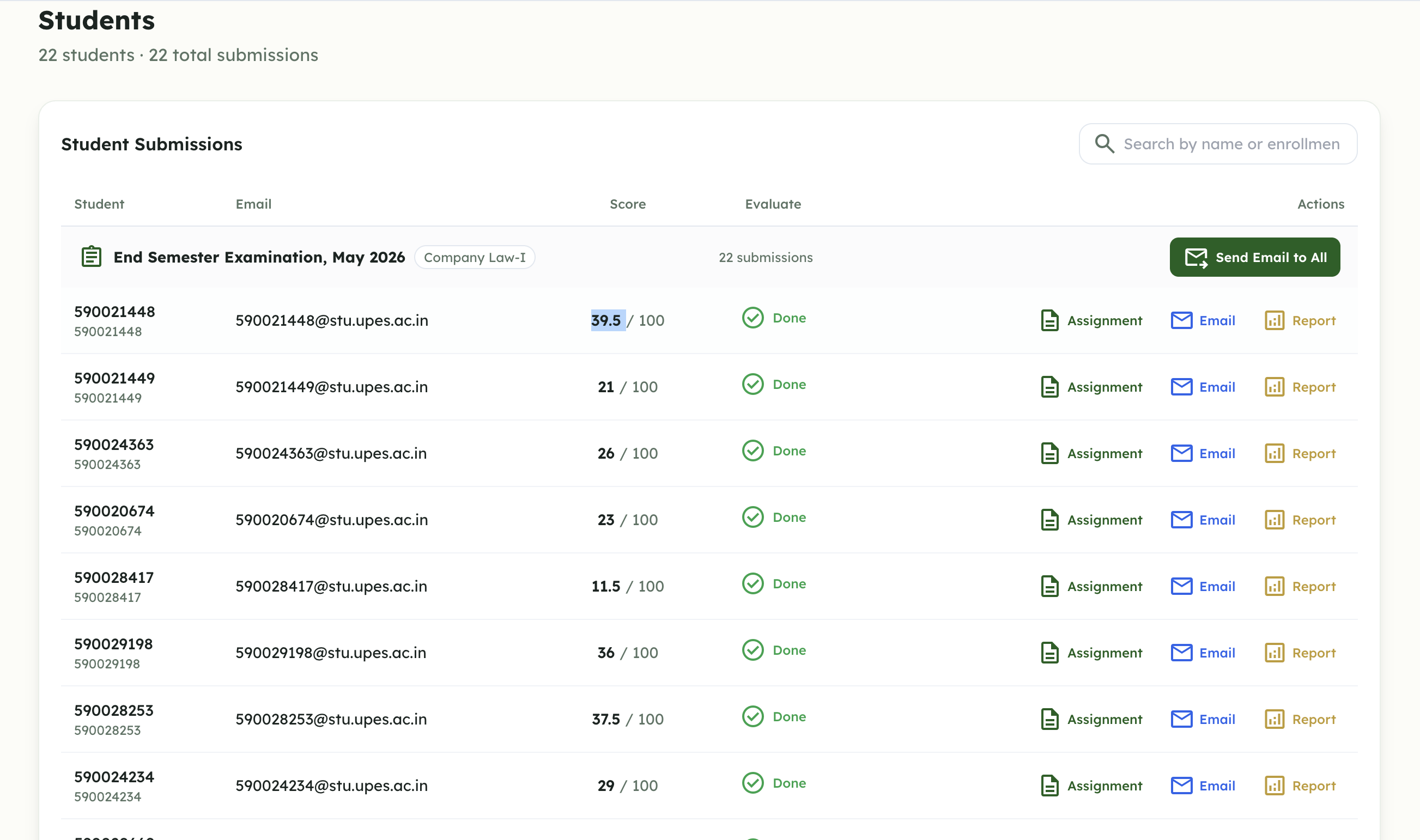
Faculty review every AI-generated score before results are published. Overrides happen in one click.
When comparing modern evaluation systems, IT administrators must look past marketing claims and examine the technical capabilities regarding descriptive text.
| Feature Requirement | Standard OMR Systems | Generic AI Writers | BigChalkBox Answer Sheet Evaluation |
|---|---|---|---|
| Descriptive Text Grading | None (MCQ only) | Inconsistent (hallucinates logic) | Strict semantic mapping to faculty rubrics |
| Handwriting Extraction | Requires specific bubbles | Poor with regional cursive | Specialized Indian handwriting OCR |
| Diagram Evaluation | None | None | Analyzes labels and structural logic |
| Faculty Override Interface | N/A | Requires complex prompt engineering | Click-and-approve visual dashboard |
BigChalkBox is explicitly designed for the rigorous, regulated environment of university-level subjective testing, rather than generic text generation.
To understand the operational difference, consider an autonomous college deploying software for a 2,000-student History examination.
| Deployment Phase | Using Standard OMR | Using BigChalkBox |
|---|---|---|
| 1. Exam Setup | Forces faculty to convert complex questions into multiple-choice. | Faculty maintain their standard 10-mark descriptive essay questions. |
| 2. Scanning | Students must use specialized proprietary OMR sheets. | Students use standard university booklets; clerks scan them in bulk. |
| 3. Evaluation | Instant, but only tests rote memorization. | AI processes semantic arguments against the rubric in the background. |
| 4. Quality Control | No review needed, but academic depth is lost. | Faculty review the AI's logic on a dashboard and approve the final score. |
| 5. Student Feedback | Student receives a raw score (e.g., 65/100). | Student receives a PDF showing exactly where they missed rubric points. |
While OMR provides speed at the cost of academic depth, BigChalkBox provides speed while preserving the rigor of descriptive assessment.
Even the most advanced university assessment platform in 2026 cannot operate completely autonomously. University regulations and the inherent creativity of students demand that a human educator retains ultimate authority over the final grade.
BigChalkBox addresses this through a mandatory review architecture. The AI acts as a highly efficient teaching assistant, proposing scores based on the rubric and highlighting relevant text in the student's answer. However, these scores remain unverified until an authorized faculty member logs in.
The faculty member must review the proposed score alongside the original scanned image and explicitly click "Approve" or override the AI's suggestion. This "Human-in-the-loop" design ensures regulatory compliance and academic integrity.
Institutions often waste budgets on software that looks impressive in a sales demo but fails during end-semester examinations. Avoid these procurement mistakes:
A successful procurement tests the software against the ugliest, most complex realities of the institution's current workflow.
Before a university signs a contract for new evaluation software in 2026, the purchasing committee should verify the following criteria:
| Readiness Check | Yes or no |
|---|---|
| The software accurately extracts regional Indian handwriting styles | |
| The platform evaluates descriptive paragraphs using semantic NLP | |
| The system forces human faculty review before results can be published | |
| The vendor can demonstrate seamless integration with the university's ERP |
Confirming these features ensures the university invests in a transformative solution rather than an expensive band-aid.
Indian universities can no longer afford to delay results due to manual checking bottlenecks, nor can they compromise academic rigor by forcing all exams into multiple-choice formats. The best software combines AI speed with human authority.
To evaluate the market-leading solution against your own institutional requirements, schedule a custom demonstration or explore the features of Answer Sheet Evaluation today.