How to Grade Handwritten Exams Faster (AI Benchmark)
Grading handwritten exams takes weeks. Answer Sheet Evaluation by BigChalkBox processes a 500-student batch in under 15 minutes while faculty retain full approval control.
Looking for automated evaluation? Answer Sheet Evaluation handles handwritten OR-questions, providing the scale Indian colleges demand.
Indian colleges face massive student volumes and exceptionally tight academic calendars that break standard grading tools. An automated education assessment software designed for India, like Answer Sheet Evaluation by BigChalkBox, processes thousands of subjective handwritten papers in hours. Faculty-defined criteria are applied consistently by the AI across every script, while human educators retain final approval authority.
When a mid-sized Indian university conducts its end-of-semester examinations, the volume of paper generated is staggering. A single core subject might involve 5,000 students writing 20-page descriptive answer booklets. This creates a logistical nightmare for the examination branch, which must securely store, distribute, and collect these bundles from evaluators.
Western grading tools, which are primarily built for short assignments or digital submissions, buckle under this physical volume. They also struggle with the "OR" question formats (e.g., "Attempt any 5 out of 8") that are standard in Indian curricula. A localized university assessment platform must be built explicitly for these structural realities.
Automating the evaluation workflow is no longer a luxury for Indian institutions; it is a fundamental requirement to release results on time and maintain the academic calendar.
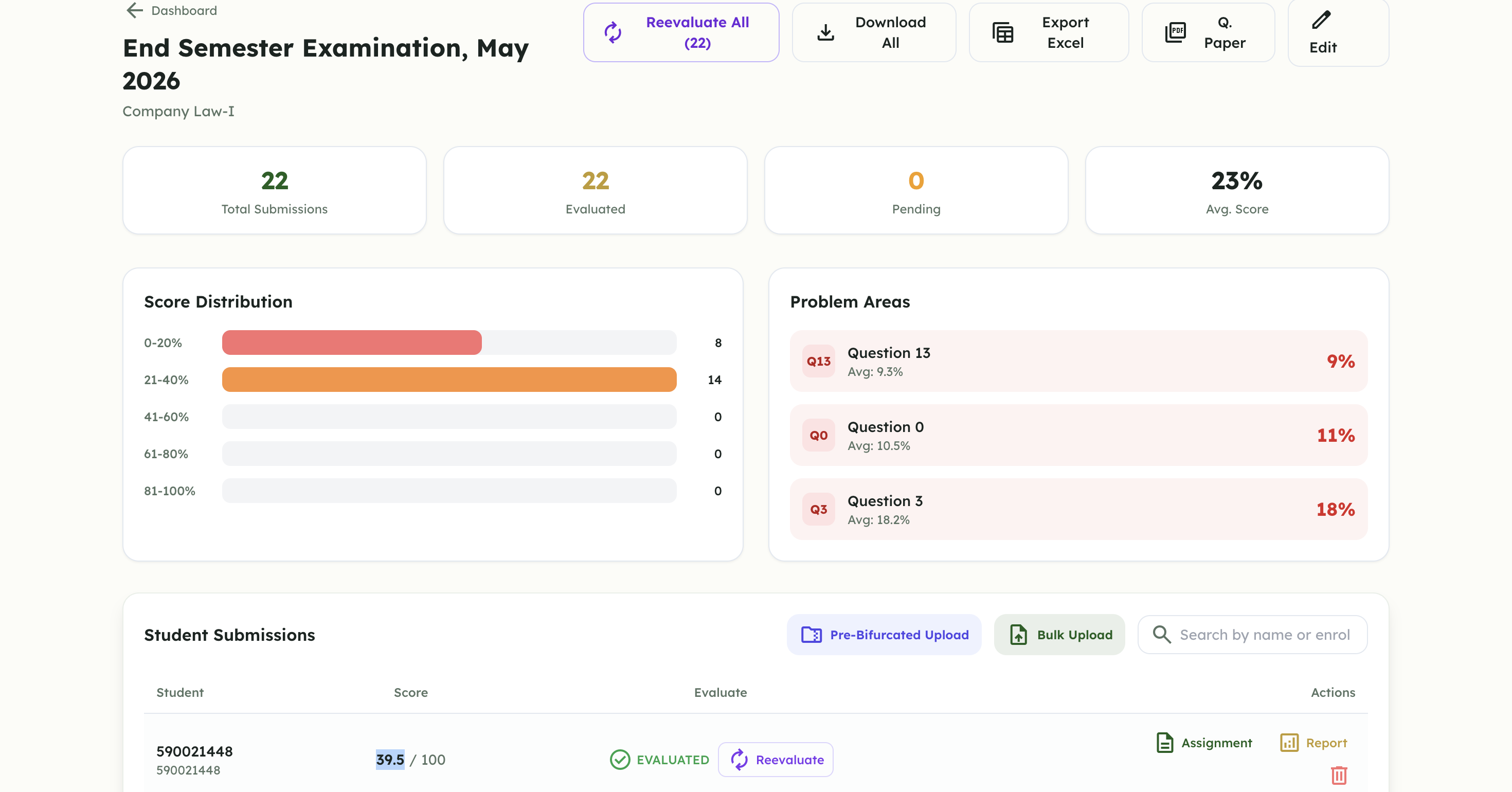
Batch-level results dashboard. Faculty see the full class performance at a glance before publishing.
A platform built for India must handle more than just text extraction. It must manage the complex logic embedded in the examination structure itself.
| Examination Challenge | Traditional Manual Handling | BigChalkBox Automated Handling |
|---|---|---|
| "Best of" internal choices | Evaluator manually tallies and strikes out lower scores | System automatically calculates and applies the best score |
| Regional cursive handwriting | Evaluator struggles to read, leading to subjective marking | Localized OCR extracts text with high precision |
| Part A and Part B sections | Evaluator manually flips pages to ensure all sections are graded | System tracks completion and prevents submission if incomplete |
| Front page totaling | Clerks manually add up marks, frequent arithmetic errors | Zero arithmetic errors; system calculates instantly |
By automating these structural and arithmetic tasks, the software frees the faculty to focus entirely on academic review.
Consider an autonomous engineering college trying to evaluate 5,000 scripts for "Data Structures" within a 7-day window. Here is how the BigChalkBox pipeline handles the load.
| Deployment Step | Action Taken | Time Required |
|---|---|---|
| 1. Scanning | Clerks feed physical booklets into high-speed ADF scanners. | 2 Days (concurrently with exams) |
| 2. Rubric Creation | The Chief Examiner defines the marking scheme in the portal. | 1 Hour |
| 3. AI Processing | The system processes the 5,000 PDFs against the rubric. | 4 Hours (Background process) |
| 4. Faculty Review | A team of 5 faculty log in to review and approve the AI scores. | 3 Days |
| 5. Result Declaration | The Controller of Exams clicks "Publish" to send data to the ERP. | Instant |
This workflow condenses a month-long evaluation bottleneck into a verifiable, stress-free week.
A critical concern for Indian academic councils is the loss of control over the evaluation process. However, legitimate AI grading systems are built to amplify human judgment, not replace it.
In BigChalkBox, the AI acts as a high-speed assistant that proposes a score based strictly on the rubric defined by the Chief Examiner. The system cannot unilaterally publish a result. Every proposed score is held in a quarantine dashboard.
An authorized faculty member must log in, review the AI's logic alongside the original handwritten scan, and click "Approve". If the faculty member disagrees with the AI, they simply override the score with their own judgment. The human always has the final say.
When Indian universities attempt to digitize their evaluation process, they frequently make structural errors that derail the project. Avoid these critical mistakes:
Proper hardware procurement and faculty training are just as important as the software itself.
Before a Controller of Examinations commits to a digital transition, they should audit their institutional readiness using this checklist:
| Readiness Check | Yes or no |
|---|---|
| The university possesses heavy-duty scanners capable of 60+ pages per minute | |
| The selected software natively handles "Best of" internal choices | |
| Faculty have defined digital rubrics before the exams are conducted | |
| The software vendor provides localized, on-the-ground support in India |
Meeting these criteria ensures the university avoids catastrophic delays during the critical result declaration window.
The era of manual, paper-heavy evaluations is over. By adopting an automated system designed for the scale and complexity of Indian higher education, universities can declare results faster, eliminate re-evaluation requests, and reduce faculty burnout.
To see how a localized solution handles your institution's specific examination formats, schedule a strategic consultation or explore the high-volume capabilities of Answer Sheet Evaluation today.